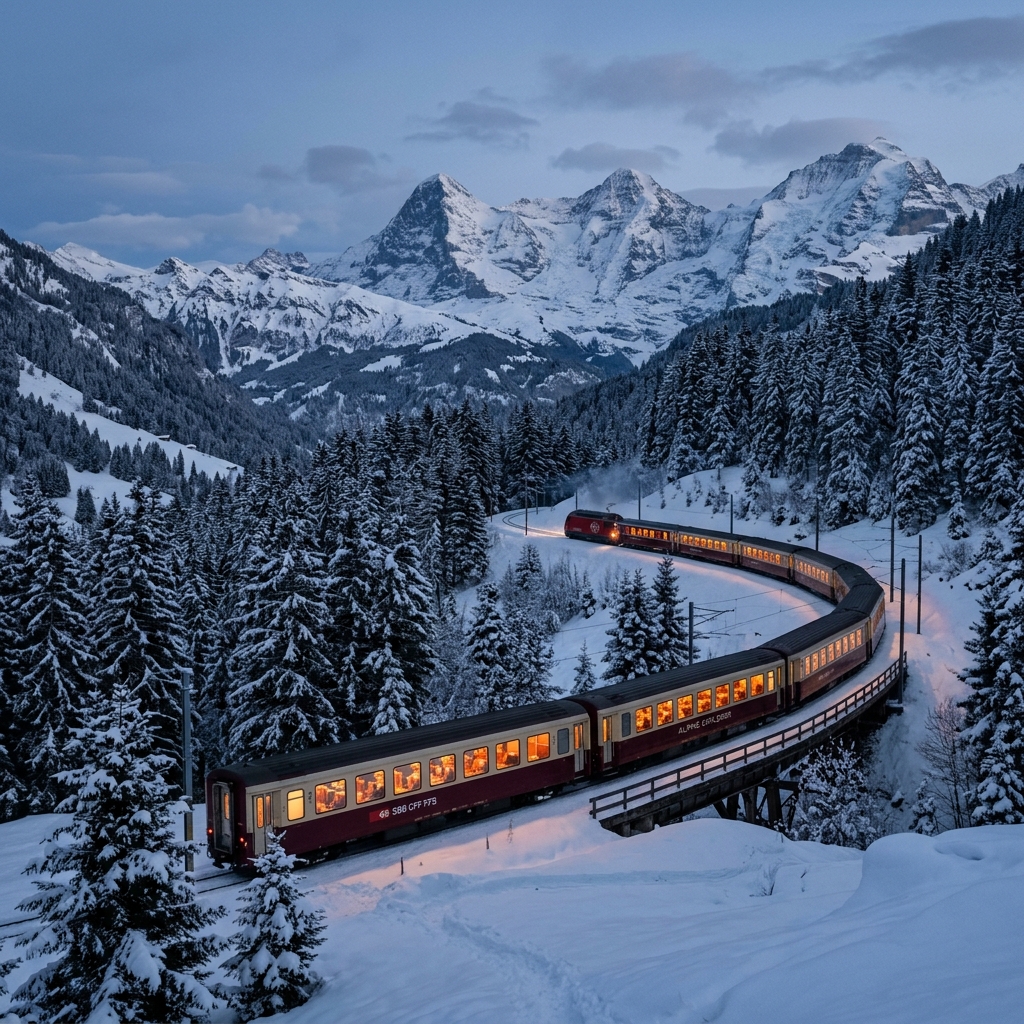
There is a version of Europe that most summer visitors never see. It exists in the gap between the last tour bus of October and the first of April, in cities that stop performing for the camera and return to being places where people live. It exists on train lines where the scenery has transformed, where the Bernina Pass is three metres deep in snow and the Glacier Express crosses a white world that the summer photographs, however beautiful, cannot fully convey.
Winter train travel in Europe is the same infrastructure applied to a different continent. The trains run. The cities are open. The prices are lower. The crowds are gone.
Why Winter Changes Everything
Pricing: Advance train fares in winter are typically 30–60% lower than the equivalent summer bookings. A Paris to Zurich TGV that costs €90 in July may be bookable for €39 in February. Accommodation follows the same curve, a hotel in Prague that charges €180 in August charges €90 in January. A two-week European rail trip in February costs roughly half what the same trip costs in July.
Crowds: Florence’s Uffizi in January has no queue. Vienna’s Kunsthistorisches Museum in February is handled at a walk, not a shuffle. The Bernina Express has empty compartments. Prague’s Charles Bridge can be walked alone at 8am in snow. The summer versions of these experiences are different in kind, not just in degree.
Scenery: Alpine routes are transformed by snow. The Landwasser Viaduct on the Albula Railway (part of the Glacier Express route), a 65m stone arch curving across a deep gorge, is extraordinary in any season. In winter, the gorge is filled with snow, the forest on either side is white, and the train crosses in silence above it all. The Bernina Express at 2,253m passes the Morteratsch Glacier in conditions that make the field look genuinely Alpine, not the Alpine approximation of summer, but the real thing.
Night trains are better in winter. The absence of daylight outside the window removes the reason to stay awake; the sleeper becomes what it should always be, a bed that moves you from one place to another while you sleep.
Light: This is the counter-argument. Winter daylight in northern Europe runs 7–9 hours (London, Amsterdam, Copenhagen in December); in central Europe, 8–10 hours. For scenic daytime routes, this limits your window. Plan daylight travel between 9am and 4pm. Start scenic journeys at the earliest possible departure.
The Best Winter Train Routes
The Glacier Express (Zermatt to St Moritz)
The Glacier Express is a marketing triumph that is also a genuine scenic railway. The 291km route from Zermatt (base of the Matterhorn) to St Moritz (luxury ski resort in the Engadin valley) takes 8 hours and crosses 91 tunnels, 291 bridges, and the Oberalp Pass at 2,033m. It is operated by the Rhaetian Railway (RhB) and the Matterhorn Gotthard Bahn.
In winter, the Oberalp Pass fills with snow, sometimes several metres deep, the train running through a white corridor cut through drifts above the pass. The Landwasser Viaduct at Filisur crosses a limestone gorge filled with frost and snow. The departure from Zermatt, past the Gornerglacier, is through terrain that has no equivalent anywhere else on a scheduled passenger service.
Practical: One train per direction per day in winter (approximately 09:52 Zermatt to 18:03 St Moritz). Reservation required (CHF 13–33). Total fare including reservation: approximately CHF 130–160 Zermatt–St Moritz. BritRail, Eurail, and Swiss Travel Pass holders pay the reservation fee only. Book at rhb.ch or Rail Europe. The dining car serves reasonably good food; the panoramic windows make any seat adequate, but the right side (travelling east) gives the best Landwasser views.
For a comprehensive guide to this route, see our Glacier Express guide.
The Bernina Express (Chur/Davos to Tirano)
The Bernina Express crosses the highest railway pass in the Alps, 2,253m at the Bernina Pass, on a narrow-gauge track that is a UNESCO World Heritage Site. The 145km route (Chur to Tirano) descends from the white world of the Engadin to the palm trees of the Valtellina valley in northern Italy in four hours, one of the most dramatic changes of scenery available on any scheduled train service.
In winter: the Bernina Pass is snow-covered from November through April. The Morteratsch Glacier (visible from the train) is at its most visible against white surroundings. The descent past Poschiavo and the spiral loops (the train loops around itself on helical curves to manage the gradient) is if anything more dramatic in snow.
Practical: Daily winter service, with the full Chur–Tirano Bernina Express running once per direction. Book at rhb.ch. You need a reservation (CHF 13); Swiss Travel Pass and Eurail covers the fare. The Tirano terminus in Italy connects with the Trenord regional trains south toward Milan (2h15 to Milan Centrale).
Our Bernina Express guide covers this route in detail.
Night Trains: The Winter Advantage
Night trains resolve the winter daylight problem elegantly. When you board at 22:00 and arrive at 08:00, the eight hours of darkness outside the window are eight hours of sleep. The cost of a sleeper cabin in winter, typically €60–120 for a private cabin, significantly less than a hotel night, makes the economics compelling.
ÖBB Nightjet network: Austria’s ÖBB runs the most extensive night train network in Europe. Key winter routes:
- Vienna to Hamburg (12h): Departs Vienna Hauptbahnhof at 22:15, arrives Hamburg Hbf at 10:11. Passes through Salzburg, Munich, and the North German Plain.
- Vienna to Brussels (14h): Via Cologne. Connects the Austrian and Belgian rail hubs.
- Vienna to Paris (13h via Strasbourg): Departs Vienna at 20:25, arrives Paris Est at 09:58 the next day.
- Zurich to Amsterdam (13h): Via Basel and Cologne. Connects Switzerland with the Netherlands overnight.
- Innsbruck to Rome (via Munich and ÖBB/Trenitalia joint service): Day or night options.
For the full network and booking, see our night trains in Europe guide.
Christmas Market Train Routes
The Christmas market circuit from late November through late December is one of the most satisfying ways to use a Eurail pass in winter.
The Rhine corridor: Paris Gare de l’Est to Strasbourg (2h15 by TGV) gives you the oldest Christmas market in France (running since 1570). From Strasbourg, cross the Rhine to Freiburg im Breisgau (30 minutes by regional train) for the German Freiburg market. Continue north to Cologne (3h by IC), then to Nuremberg (2h30 by ICE) for the Christkindlesmarkt, one of Germany’s most famous. Vienna is 4h from Nuremberg; its Rathausplatz market, in front of the illuminated Gothic Town Hall, is among the grandest in Europe.
Total distances: Paris to Vienna on this circuit is approximately 1,500km, entirely connected by scheduled trains without a car.
The Alpine option: Zurich (2h30 from Paris by TGV) has markets at the main station and Niederdorf. Innsbruck’s old town market (2h from Zurich) is exceptional, the Baroque arcades lit up, the Nordkette mountains above. Salzburg (1h50 from Innsbruck by direct train) has the Domplatz market in the cathedral square.
The Best Winter Cities
Vienna
Vienna is arguably the finest city in Europe for winter travel. The reasoning: a museum collection of extraordinary depth (Kunsthistorisches, Natural History, Albertina, Belvedere), an opera house that schedules performances almost every night from September through June, a café culture designed for sitting in warmth, and a Christmas market tradition that treats the season with genuine seriousness.
The Café Central (Herrengasse 14) and the Café Landtmann (Dr-Karl-Lueger-Ring 4, the coffee house across from the Burgtheater) are the correct answers to a cold afternoon in Vienna. Order a Melange (coffee with steamed milk) and sit for as long as you need.
Rail connections from Vienna in winter: Salzburg (2h30 by Railjet), Budapest (2h40 by Railjet, see our Budapest slow travel guide), Prague (4h by Railjet), Zagreb (6h by overnight).
Prague
Prague in December and January is colder than Vienna (temperatures regularly reach -5 to -10°C) but the city in snow is one of the more convincing arguments for the existence of urban planning. The Charles Bridge at 8am in frost, with no tour groups; the castle complex on the hill visible from the bridges in early morning mist; the Art Nouveau café Café Imperial (Na Poříčí 15) for breakfast.
The Christmas market at Old Town Square (late November to early January) is large, commercial, and extremely popular. The smaller market at Náměstí Míru in Vinohrady is better, more local, less tourist.
Rail connections: Prague to Vienna is 4h by Railjet (EC/RJ services run approximately hourly). Prague to Berlin is 4h by EC (via Dresden, with excellent views of the Elbe valley in the Saxon Switzerland national park). Prague to Krakow is 7h by direct connection, possible but long; overnight is better.
Budapest
Budapest in winter: the thermal baths are at their best when the air temperature is below zero and the outdoor pools steam. The Széchenyi baths in City Park are open year-round; go on a weekday morning. The central market hall (Vásárcsarnok, 1897) is full and functioning in winter, with local produce and the paprika vendors and embroidery sellers on the upper floor.
The city centre, Pest, on the flat east bank, is lit along the Danube embankment through the Christmas period and into January. The Castle District on the Buda side, across the Chain Bridge, is quiet in winter. The Fisherman’s Bastion gives views across the Danube to Parliament that are among the finest urban panoramas in Europe.
For a full guide, see our Budapest slow travel guide.
Ljubljana
The underrated option. Ljubljana (pronounced lyoo-BLYAH-nah) is the capital of Slovenia, connected to Vienna by direct Intercity train in 2h30 and to Venice in 3h30. It has a compact medieval old town, a castle on the hill above, and the Prešeren Square at the centre, all of which are beautiful under snow and which receive a fraction of the visitors that any comparable city in western Europe attracts.
The city is walkable in 90 minutes at a tourist pace; give it three days to understand what makes it extraordinary. The triple bridge at Tromostovje (designed by Jože Plečnik, Slovenia’s answer to Gaudí), the central market along the Ljubljanica river, and the Dragon Bridge are the standard sights. The less-standard sights are the Plečnik-designed cemetery of Žale and the National and University Library, both the work of the same architect, both extraordinary.
The food: winter in Ljubljana means cabbage soup, polenta with game, and the Slovenian tradition of natural wine that predates its fashionability everywhere else.
Passes and Booking in Winter
Eurail pass: Better value in winter because you’re likely to make more bookings spontaneously (lower crowds mean seats are available without 6-week-ahead advance booking). The Eurail Global pass (15 days within 2 months: approximately €400) works well for a Central European winter circuit. Reservation fees apply on high-speed trains (€4–13) and are mandatory on Glacier Express and Bernina Express.
Swiss Travel Pass: Essential if your winter trip is Switzerland-centred. The pass covers all Swiss Federal Railways trains, city transport, many alpine railways, and museum entries. A 15-day consecutive pass is approximately CHF 580. The Glacier Express and Bernina Express reservations are additional.
Point-to-point advance fares: For fixed-itinerary winter travel booked 4–8 weeks ahead, individual advance tickets almost always beat the pass on the major routes. The Eurail advantage is flexibility, spontaneous travel, day passes, and connections where individual tickets would be expensive.
Related Reading: Glacier Express guide, Bernina Express guide, Night trains in Europe, Budapest slow travel guide