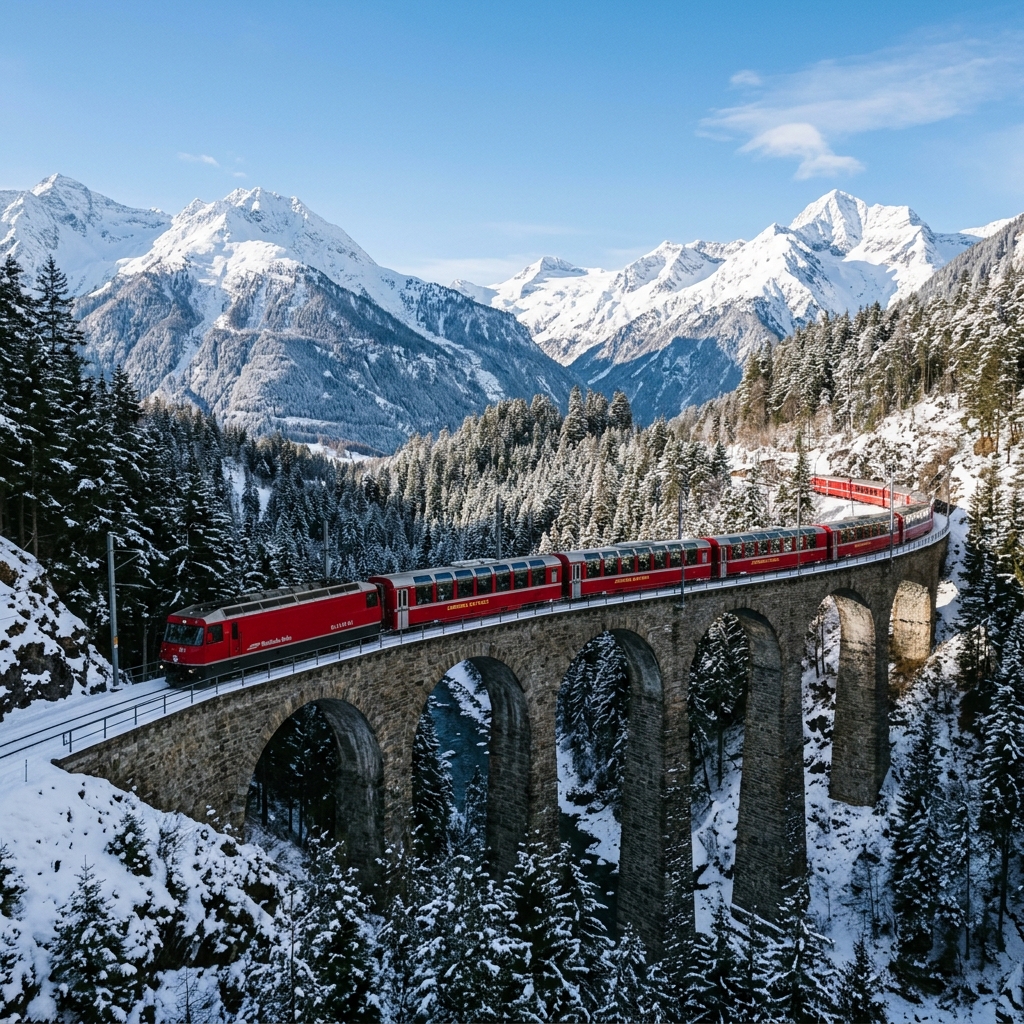
The Bernina Express does something rare. It crosses an international border, climbs to 2,253 metres above sea level, descends past palm trees into an Italian piazza, and does the whole thing in under four hours. No other scheduled train journey in Europe compresses that much altitude change, that many climatic zones, or that density of engineered spectacle into a single afternoon.
The route runs from Chur, the oldest city in Switzerland, through St. Moritz, over the Bernina Pass, and down through the Italian Alps to Tirano. The Rhaetian Railway that operates it has been a UNESCO World Heritage Site since 2008, recognised for the way its engineers threaded narrow-gauge track through terrain that should, by any reasonable assessment, have been impossible. (UNESCO, inscribed 2008)
This guide covers the full route, the key sights, how to book a panorama car, the best seasons to travel, and what to do when you reach Tirano. It also addresses the question every Switzerland rail traveller eventually asks: Bernina Express or Glacier Express? If you are still sketching the wider trip, start with our complete guide to travelling Europe by train and come back here for the Alpine centrepiece.
How this guide is put together: everything below is synthesised from Rhaetian Railway’s published route and fare information, the UNESCO World Heritage listing, and recent traveller reports. We have not ridden every departure — no one should claim to — so always confirm current times and prices at rhb.ch before you book.
TL;DR: The Bernina Express runs from Chur to Tirano (Italy) in approximately 4 hours, crossing the Bernina Pass at 2,253 m, the highest transalpine railway crossing in the world. A mandatory, seasonally priced seat reservation (recently in the CHF 14–26 range) is required for the panorama coaches and is worth booking months ahead in summer. The route is UNESCO-listed and runs year-round. You can also ride the exact same rails on an ordinary regional train with no reservation at all — more on that below. (Rhaetian Railway, 2026)
Table of Contents
- What Is the Bernina Express?
- What Is the Full Route from Chur to Tirano?
- What Are the Unmissable Engineering Highlights?
- Panorama Car vs Regular Car: Is the Upgrade Worth It?
- Summer vs Winter: Which Season Is Better?
- Bernina Express vs Glacier Express: Which Should You Choose?
- How to Book the Bernina Express
- What to Do in Tirano
- Practical Tips Before You Board
- Is the Bernina Express Worth It?
- Frequently Asked Questions
- Further Reading
What Is the Bernina Express?
The Bernina Express is a panoramic train operated by the Rhaetian Railway (Rhätische Bahn, or RhB) connecting Chur in the Swiss canton of Graubünden with Tirano in northern Italy. Designated a UNESCO World Heritage Site in 2008 as part of the Rhaetian Railway in the Albula/Bernina Landscapes, it’s recognised as one of the greatest railway engineering achievements in history. (UNESCO, inscribed 2008) The full journey takes approximately 4 hours.
The train is narrow-gauge (metre gauge), which is partly why it can handle gradients and curves that standard-gauge railways cannot. It climbs from Chur at 585 metres to the Ospizio Bernina station at 2,253 metres, a rise of nearly 1,700 metres, without rack-and-pinion assistance. That’s an engineering fact worth pausing on. The track clings to the mountain using nothing but adhesion, tight curves, and spiral loops cut into the rock, on gradients that reach 7 per cent at their steepest. (Rhaetian Railway, 2026)
What distinguishes the Bernina Express from other panoramic trains is the variety. In a single journey you pass glaciers, mountain lakes, sub-alpine meadows, and eventually terraced vineyards and Italian hill towns. The scenery doesn’t hold still. Every ten minutes it becomes something different. RhB markets the route as a trip “from glaciers to palms,” and for once the brochure language understates the case.
What Is the Full Route from Chur to Tirano?
The full Bernina Express journey runs Chur to Tirano, approximately 144 km, in around 4 hours. The shorter St. Moritz to Tirano segment takes approximately 2.5 hours and covers the most dramatic section of the route. (Rhaetian Railway, 2026) Many travellers choose the shorter version if they’re based in St. Moritz or the Engadin valley.
Chur to St. Moritz (Albula section, approximately 1.5 hours)
The journey begins in Chur, Switzerland’s oldest city, with a Roman-era old town worth an hour before you board. The train climbs the Albula valley through Tiefencastel and Filisur, where the famous Landwasser Viaduct carries the track, before plunging into the 5.9 km Albula Tunnel and emerging at Preda. It then descends through the extraordinary Albula spiral tunnels to reach Samedan and St. Moritz in the upper Engadin.
St. Moritz to Tirano (Bernina section, approximately 2.5 hours)
This is where the journey shifts into a different register. From St. Moritz the train climbs steadily, passing the twin lakes at the pass — the white Lago Bianco and the dark Lej Nair — with the Morteratsch glacier country below. Ospizio Bernina station at 2,253 metres is the highest point; the train simply stops there, allowing you a moment to register just how far above sea level you’ve climbed. Then the descent begins: dramatic, sustained, and increasingly Italian in character, with the Piz Palü massif in view from Alp Grüm and the switchbacks stacking up above Poschiavo all the way down to the border at Campocologno and the vineyards of Valtellina.
Citation capsule: The Bernina Express route between Chur and Tirano spans approximately 144 km of narrow-gauge track, reaching its highest point at Ospizio Bernina station (2,253 m). The complete journey takes around 4 hours; the St. Moritz–Tirano segment runs approximately 2.5 hours. The entire Chur–Tirano route is UNESCO World Heritage-listed as part of the Rhaetian Railway in the Albula/Bernina Landscapes. (UNESCO, inscribed 2008)
What Are the Unmissable Engineering Highlights?
The Landwasser Viaduct (Filisur). The single most photographed structure on the route: a 65-metre-high, six-arch stone viaduct that the train crosses before disappearing straight into the cliff face at the Landwasser Tunnel. There is no approach ramp and no forewarning — the track simply leaves the valley floor and flies. Travellers report that sitting on the right side of the train travelling south gives the cleanest view as the viaduct sweeps in, though in truth both sides get a look because of the curve. For the classic postcard angle from below, the Landwasser viewpoint near Filisur is a short walk from the station — one reason some travellers break the journey here on the way back.
The Albula spirals (Preda to Bergün). To lose altitude on a mountainside without rack rail, the line loops over and under itself in a stack of spiral tunnels and traverses between Preda and Bergün. Watch the valley floor out of one window, then the same floor again from a different angle minutes later. It is the clearest illustration of why UNESCO inscribed this railway as an engineering landscape rather than a single structure. (UNESCO, inscribed 2008)
Ospizio Bernina (2,253 m). The highest railway crossing of the Alps, and a scheduled stop. The air is thin enough to notice on the platform, and the station hotel beside the lake is a destination in its own right for hikers in summer.
The Montebello curves and Alp Grüm balcony. Below the pass, the descent to Poschiavo unfolds in broad stacked loops — best appreciated from the Montebello viewpoint outside Poschiavo, a destination for photographers who want the whole horseshoe of track in one frame. Further down, Alp Grüm station sits on a ledge with the Piz Palü glacier massif dead ahead; on the regional trains you can simply get off here, walk, and catch a later train.
The Brusio spiral viaduct. Just before the Italian border, the line executes a full 360-degree circle on an open stone viaduct to shed the last of its altitude into the valley. The train crosses above its own track. It is the engineering equivalent of a signature at the bottom of a page, and it is visible — briefly — from inside the carriage as the curve closes.
7 per cent, no rack. Worth repeating as a headline: the Bernina line is one of the steepest adhesion railways in the world, climbing and descending grades of up to 70 per mil on wheel grip alone. (Rhaetian Railway, 2026) That constraint is the reason for every spiral, viaduct, and curve on the list above.
Panorama Car vs Regular Car: Is the Upgrade Worth It?
This is the decision that actually changes your day, and it is where most guides go vague. Here is the honest breakdown.
What the panorama coach is. The designated Bernina Express trains carry purpose-built panoramic coaches with windows that curve into the roofline, so the mountains above are visible without craning. Seats require a mandatory reservation with a seasonal fee (recently in the CHF 14–26 range depending on travel period; RhB publishes the current scale). The coaches are climate-controlled, the windows are tinted, and there is bistro or at-seat trolley service depending on the composition.
What most guides underplay: the regular trains use the same track. Hourly-ish regional trains (labelled S/RE services on the Bernina line) run over the identical rails between Chur or St. Moritz and Tirano, with no reservation, no supplement, and windows that tilt open for photography — which the panoramic windows do not. A Swiss point-to-point ticket, a Eurail/Interrail pass, or a Swiss Travel Pass covers the journey exactly the same way. If your budget is tight, this is the single best money-saving fact about the whole route, and it pairs well with our guide to cheap rail travel in Europe.
So which should you book?
Book the panorama coach if: it’s your one marquee rail day of the trip, you’re travelling in peak summer when you want a guaranteed forward-facing seat, you value the overhead glass in the forests and spiral sections, or you’re giving the journey to someone as a gift. The supplement is small relative to what you’ve already spent to be in Switzerland at all.
Ride the regional if: you’re a photographer who wants open windows (glare on panoramic glass is real), you want to hop off at Alp Grüm, Ospizio Bernina, or Brusio and continue later — something the through-express doesn’t allow — or you simply prefer to spend the CHF 14–26 on a long lunch in Poschiavo. Many seasoned travellers ride the panorama car one direction and the regional back, and report it is the best of both.
The one thing both share: the scenery. The rails don’t know which livery is on top of them.
Summer vs Winter: Which Season Is Better?
Summer (June–September). Long daylight, green terracing in Valtellina, high-alpine trails open at Ospizio Bernina and Diavolezza, and the fullest schedule of through departures plus the connecting Bernina Express Bus to Lugano. The trade-offs: peak crowds in July and August, panorama reservations that can sell out weeks ahead, and afternoon haze that can soften the long views. Late June and early September hit the sweet spot for most travellers — full schedule, thinner queues.
Winter (roughly December–March). The pass becomes a snow corridor: drifts tower beside the line after heavy snowfall, the lakes at the summit freeze white, and the contrast between the Arctic-looking pass and the snow-dusted vineyards of Valtellina gets even sharper. Trains run year-round on the route, crowds thin dramatically, and panorama availability is usually bookable within a week or two. The trade-offs: short daylight (the southern descent may finish in the dark on late departures), colder platforms, and fewer onward connections on the Italian side. Check current timetables at rhb.ch — winter frequency patterns differ from summer’s.
Shoulder seasons (April–May, October–November). Lowest fares and emptiest coaches, but the pass can look brown rather than white, the bus connection to Lugano may not run in the off-season, and maintenance closures occasionally substitute bus sectors for short stretches. If you travel shoulder, build a little schedule slack.
Our honest default: first-time visitors should target late June or September; returning travellers and photographers should try winter at least once.
Bernina Express vs Glacier Express: Which Should You Choose?
Both are RhB-flagship panoramic trains, both start or end in St. Moritz, and both appear on every “best train journey” list — including our own round-up of the world’s best train journeys. They are, however, very different days out.
| Bernina Express | Glacier Express | |
|---|---|---|
| Route | Chur/St. Moritz → Tirano (Italy) | Zermatt ↔ St. Moritz |
| Duration | ~4 hours | ~8 hours |
| High point | Ospizio Bernina, 2,253 m | Oberalp Pass, ~2,044 m |
| Signature feature | Altitude drama, glaciers to palms | Sustained high valley scenery, prestige dining |
| Ends in | Italy (onward to Milan) | Two ski resorts |
Choose the Bernina if you want maximum contrast per hour, a border crossing, an Italian lunch, or you’re continuing to Milan or Lake Como. It’s shorter, cheaper overall, and the descent past Brusio and into Valtellina is the more dramatic single stretch of the two.
Choose the Glacier if you want a full-day ceremonial experience — the dining car, the slow cinematic rhythm, the Matterhorn-adjacent arrival in Zermatt. It’s a pilgrimage; the Bernina is a thriller.
Doing both is a natural combination, and you don’t even need to backtrack: arrive in Zermatt, ride the Glacier Express east to St. Moritz, spend a night, then take the Bernina Express south to Tirano and Milan the next morning. The two journeys share only the St. Moritz hub and cover completely different terrain with no repeated scenery. For more Swiss rail ideas beyond both flagships, see our guide to scenic Swiss train rides beyond the Glacier Express.
How to Book the Bernina Express
Understand what you’re buying. Two separate things: the travel ticket (a regular RhB fare, or coverage via Eurail/Interrail or the Swiss Travel Pass) and the panorama-coach seat reservation (mandatory, seasonal fee, recently CHF 14–26). Booking a reservation without a valid ticket won’t get you aboard, and a pass without a reservation won’t either.
Where to book. Directly at rhb.ch, at any Swiss staffed station counter, or through the SBB Mobile app (sbb.ch), which resells RhB services and is the most convenient option once you’re in country. Eurail and Interrail passholders can book the reservation through the pass operators’ own channels as well.
When to book. For July and August, and for any travel on a tight onward connection, book the panorama car 6–8 weeks ahead — seats in peak summer can sell out many weeks in advance, particularly around Swiss public holidays. For May, June, September, and October, a few weeks is usually comfortable. Winter panorama seats are normally available within a week or two of travel. Regional trains on the same line never require a reservation at all, which is your fallback if the panorama coach is full: ride the regional one way and re-book the panorama experience for the return.
If you’re using a rail pass. Eurail, Interrail, and the Swiss Travel Pass cover the base journey on the Bernina line; the reservation fee is always extra. Pass conditions for the short Italian sector beyond Tirano vary — check your pass’s country coverage before assuming the Milan leg is included. Our full European rail pass buyer’s guide covers the maths of when a pass beats point-to-point tickets.
One-way vs return. There is no round-trip discount to chase; price it as two one-ways. Many travellers make the journey one-way as part of a Switzerland-to-Italy itinerary, which is exactly what the route was built for.
What to Do in Tirano
Tirano is not a box to tick while you wait for the train back. Give it at least the afternoon.
The border-town piazza. Within a few minutes’ walk of the station you’re standing under palms in a proper Italian square with the Alps stacked behind you — the payoff for the last four hours. The sanctuary of the Madonna di Tirano, a Renaissance church with an ornate marble facade, anchors the old town and is the historic reason the town exists at this crossing point.
Eat Valtellina. The valley’s cuisine is one of Italy’s most distinctive: pizzoccheri (buckwheat pasta with cheese and greens), bresaola air-dried beef, and chestnut-flour desserts, all matched to local Sassella and Valtellina Superiore wines from the terraced vineyards you just descended through. Lunch in Tirano after the morning train is, in many travellers’ reports, the single best value meal of a Switzerland trip, simply because you’re now paying Italian prices.
Onward connections. Trenord regional trains connect Tirano to Milano Centrale in roughly 2.5 hours, making a Chur-breakfast-Milan-dinner day genuinely possible. In the warmer months, the Bernina Express Bus continues from Tirano over Lake Como to Lugano — a separate reservation, and a way to close the loop back into Switzerland without retracing the rails. Confirm seasonal availability before you plan around it.
If you have a spare day. Work backwards up the line: Poschiavo for a chocolate-box Italian-speaking Swiss town, Brusio for the spiral viaduct at ground level, Alp Grüm for the glacier balcony. You can stitch these together with the regional trains in a single unhurried day. Keen on the wider food angle of an Italian rail trip? Our ranking of Europe’s best food cities can help you pick the next stop after Milan.
Practical Tips Before You Board
- Documents. Switzerland and Italy are both in the Schengen area; there is no passport check on the train. Non-Schengen visitors should still carry a valid travel document, as spot checks are always possible on international services.
- Luggage. Racks in the panorama coaches fill early on summer departures. A carry-on-sized bag you can lift overhead or slot at your feet removes all stress — our carry-on packing list for international travel and our guide to travelling Europe with carry-on only are built for exactly this kind of trip.
- Food and drink. Panorama services include bistro or trolley options depending on the consist; the regional trains offer little or nothing. Bringing your own picnic is a proud tradition on this line — see our guide to eating on European trains for what travels well.
- Layers. You will experience roughly 1,800 metres of altitude change and two climate zones. A warm layer for the Ospizio Bernina stop is welcome even in July; sunscreen matters at altitude even when it’s cold.
- Seat side. Because the line spirals and reverses direction constantly, there is no reliably “best” side — the panorama windows settle the argument by wrapping overhead. On regional trains, either side delivers; the light changes every few minutes regardless.
- Photography. Panorama glass is tinted and reflective; regional windows tilt open. If photos are the point of your trip, that is a genuine argument for the regional in at least one direction. Wipe the window with a cloth before the descent section — it sounds fussy and works.
- Motion. The sustained curves of the spirals can trouble sensitive stomachs, especially while reading. Look out, not down, through the spiral sections.
- Timetable hygiene. Alpine services adjust with the seasons and maintenance windows. Re-confirm your departure the night before at rhb.ch or sbb.ch rather than trusting a blog — including this one.
Is the Bernina Express Worth It?
As a synthesis rather than a slogan: yes, for nearly everyone, and the reason is ratio. Four hours, one border, 1,800 metres of descent, glaciers to vineyards, at a supplement measured in tens of francs over the ordinary fare. The Glacier Express takes twice as long for comparable prestige; most scenic trains elsewhere in Europe take twice as long for less. If you are in Switzerland or northern Italy at all, the Bernina line is close to mandatory.
The honest caveat cuts the other way too: the scenery is not gated behind the supplement. The panorama coach is a viewing instrument, not a toll. If your trip budget is genuinely tight, the regional trains give you the same UNESCO-listed line, the same Brusio circle, the same palms in Tirano, and the freedom to stop wherever the view wins. What the express sells is comfort, certainty, and those overhead windows — worth it to most, essential to none.
Our suggested default for a first visit: ride the panorama coach one way (morning departure, Chur or St. Moritz to Tirano), have a long Valtellina lunch, and come back on the regional with the windows open, hopping off at Alp Grüm if the light is right. One day, both experiences, no redundancy.
Frequently Asked Questions
Do I need a passport to travel on the Bernina Express from Switzerland to Italy?
You need a valid travel document to enter Italy, but there is no passport check on the train itself. The border crossing at Campocologno is smooth, and the train does not stop for customs or immigration. EU and Schengen-area travellers will not be checked at all. Non-Schengen visitors should carry their passport but should not expect inspection onboard.
Can I use a Eurail or Interrail pass on the Bernina Express?
Yes. Both passes cover the base fare on the line. A mandatory reservation fee still applies for the panorama coach — recently in the CHF 14–26 range depending on season — and is booked separately through SBB, the pass operators’ apps, or RhB directly. Pass coverage for onward travel beyond Tirano in Italy depends on your pass’s country list.
How far in advance should I book the Bernina Express panorama car?
For summer travel (June–September), book the panorama car at least 6–8 weeks ahead, and earlier for July and August, when seats can sell out many weeks in advance. Winter panorama availability is much more flexible, often bookable within a week or two of travel. If everything is sold out, remember the regional trains on the same line need no reservation at all.
Is the Bernina Express suitable for one-way travel from Switzerland to Italy?
It’s one of the most practical one-way rail journeys in Europe. A Chur or St. Moritz to Tirano routing, followed by a regional train to Milan, makes for an exceptional travel day: Swiss Alps in the morning, Italian city by evening. From Milan, high-speed trains connect to the rest of Italy.
Can I do both the Bernina Express and the Glacier Express on the same Switzerland trip?
Yes, and it’s a natural combination. Both trains share the St. Moritz hub. A common itinerary: arrive Zermatt, ride the Glacier Express to St. Moritz, spend a night, then continue on the Bernina Express to Tirano and Milan the next morning. The two journeys cover completely different terrain with no repeated scenery.
Further Reading
- The Complete Guide to Traveling Europe by Train — the frame this route fits into
- 8 Scenic Train Rides in Switzerland Beyond the Glacier Express — more RhB and Swiss main lines
- The 15 Best Train Journeys in the World — where this one lands in the global ranking
- European Rail Passes: The Complete Buyer’s Guide — whether Eurail, Interrail, or the Swiss Travel Pass pays off for you
- Europe by Train on a Budget — the regional-train strategy in full
- Eating on European Trains — what to pack for the descent to Tirano