Every serious traveler has a private ranking — the cities worth returning to not for the architecture or the museums but for what happens at the table. Food cities are different from cities with good food. The distinction is not subtle. A food city is a place where eating well is a collective project, where the quality of the local market is a civic matter, and where the way a particular pasta shape should be made has been contested for generations.
What follows is a synthesis, not a travel diary. It draws on the Michelin Guide’s coverage, UNESCO’s cultural-heritage listings, the documented consensus of food writers and resident reviewers, and one filter most rankings ignore: how each city fits into an overland, train-first trip. That filter matters. A food city you can only reach by plane changes the rhythm of the eating; a city you can step into off a morning train rewards a long lunch and a slow afternoon.
Two companion pieces will make any of these trips better: our guide to the best food tours in Europe for the first day in town, and how to avoid tourist traps in popular cities — because every city below also has a tourist-facing imitation of its cuisine, and the difference between the two is the whole game.
1. San Sebastián (Donostia), Spain
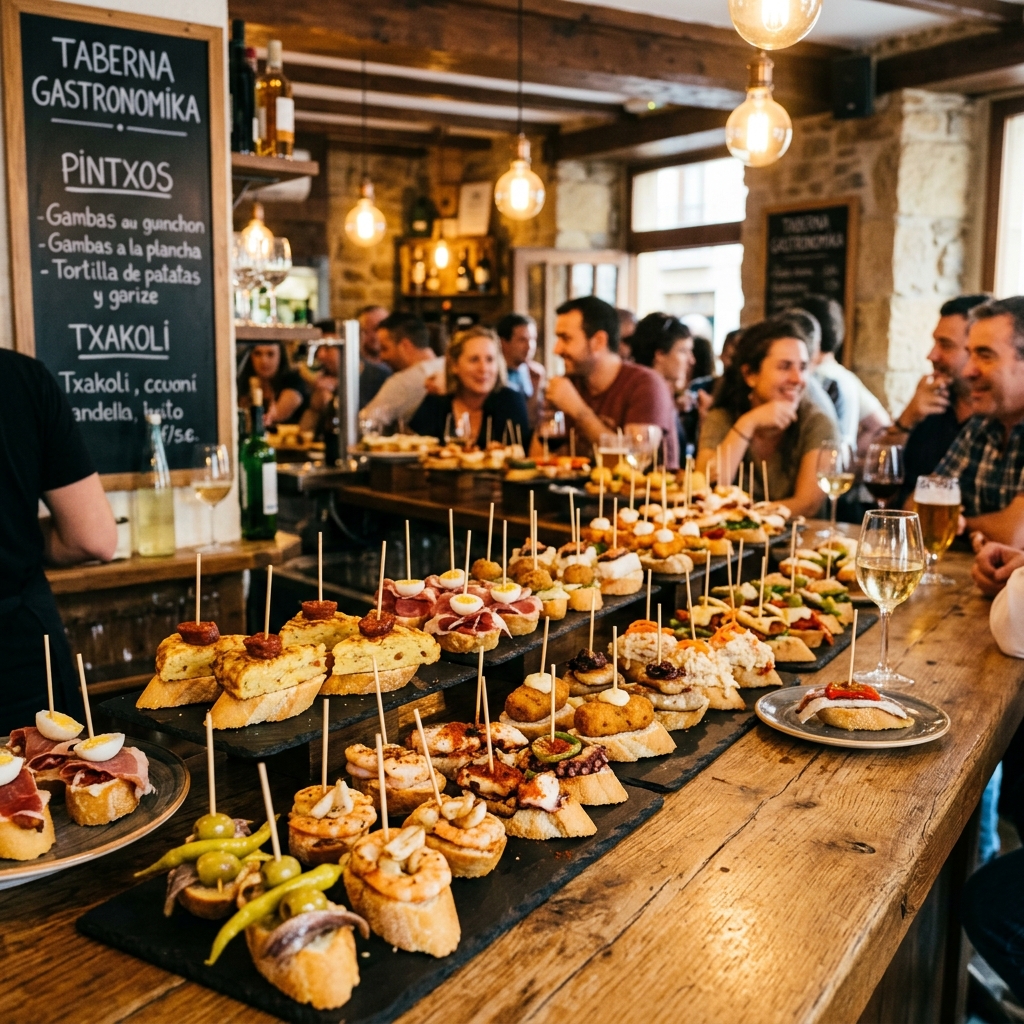
The Michelin Guide has long listed San Sebastián and its surroundings as one of the densest concentrations of starred restaurants per capita anywhere in the world. It is a useful statistic, but it misses the real argument for the place: the pintxo bars. These are the snack bars that line the streets of the Parte Vieja (Old Town), each with its own glass counter of small constructions on bread — anchovies and peppers, braised cheek, cured tuna belly — priced at a couple of euros each, available to anyone who walks in and points.
The dynamic this creates is unique in European food culture: the finest culinary city on the continent is also one where you can eat exceptionally well for €20, standing at a counter, with a glass of txakoli (the local lightly sparkling white wine). Three-star restaurants like Arzak, Mugaritz, and Akelarre set the tone; the pintxo culture democratises it entirely.
What to eat: Gilda (the original pintxo — olive, anchovy, pickle on a skewer), bacalao al pil-pil, kokotxas, idiazabal cheese, and whatever has just been placed on the bar counter at La Cuchara de San Telmo.
Getting there by train: The classic slow arrival is the TGV from Paris to Hendaye (roughly four and a half to five hours), then the short EuskoTren hop across the border into the city centre — a full morning’s travel along the Atlantic coast, and the western anchor of our route for crossing Europe overland on a small budget. From Madrid, Renfe’s Alvia services take around five hours. Bilbao is close enough for an easy day trip by bus if you want a second Basque food scene.
2. Bologna, Italy
Bologna has been called La Grassa — the fat one — since the Middle Ages, and the Bolognesi wear the name with pride. This is the city that invented tortellini, tagliatelle, mortadella, and ragù. The food is unapologetically rich, deeply traditional, and executed with an orthodoxy that borders on the religious: the official width of a tagliatella is literally registered — a gold mould was deposited with the Bologna Chamber of Commerce in 1974 — and a cook who serves spaghetti bolognese has committed a culinary crime in local eyes.
The Quadrilatero — the old market district between the main square and Via Rizzoli — is still a working food market after eight centuries. Go on a weekday morning, when the stalls are fullest and the shoppers are locals.
What to eat: Tagliatelle al ragù, tortellini in brodo (in broth, not cream sauce — the cream version is a tourist adaptation), mortadella, tigelle (small flatbreads eaten with cured meat), and crescentine fritte.
Getting there by train: Bologna Centrale sits on Italy’s high-speed spine: Florence is about 35 minutes away, Milan roughly an hour, Rome around two hours, Venice not much more than an hour. Parma and Modena — the other two poles of Emilian eating — are under an hour away by regional train, which makes Bologna the natural base for a food tour of Europe without a car.
3. Lyon, France
Lyon’s claim is different from Bologna’s or San Sebastián’s: it is the city that codified French gastronomy as a tradition accessible to the working class, not just the bourgeoisie. The bouchons — small, convivial restaurants serving Lyonnaise cuisine built around offal, pork, and cream — are a protected cultural institution. Many are certified by the Les Bouchons Lyonnais association, which verifies authenticity against defined criteria.
Paul Bocuse spent most of his life cooking here. The market Les Halles de Lyon Paul Bocuse, a covered food market on the Cours Lafayette, is his enduring monument — and one of the finest food markets in Europe, with the region’s cheesemakers, charcutiers, and pastry shops under one roof.
What to eat: Quenelles de brochet (pike dumplings in cream sauce), tablier de sapeur (breaded tripe), cervelas (pork sausage), Saint-Félicien and Saint-Marcellin cheeses, rosette de Lyon sausage, and the tarte aux pralines (rose praline tart).
Getting there by train: Lyon is 2 hours from Paris on the TGV, about 90 minutes from Marseille, and about 2 hours from Geneva — an easy addition to a Paris-to-Barcelona or Paris-to-Rome rail itinerary. If Lyon is one stop on a multi-city eating trip, our European rail pass buyer’s guide covers when a pass beats point-to-point tickets.
4. Naples, Italy
Naples operates on a different frequency from the rest of Italy. The food is louder, faster, cheaper, and — when it comes to pizza — without any credible rival on the planet. The Neapolitan pizza tradition (the art of the pizzaiuolo was inscribed on UNESCO’s Intangible Cultural Heritage list in 2017) is not a style among styles; it is the original, and the standard against which all others are measured. By near-universal agreement, a margherita at Sorbillo or Di Matteo, eaten standing at the counter for a few euros, resets your sense of what pizza can be.
Beyond pizza: the fried food culture is extraordinary (frittura, cuoppo, pizza fritta), the fish is exceptional along the waterfront at Mergellina, and the pastry tradition — sfogliatelle, babà al rum, pastiera napoletana — is one of the great dessert cultures in Europe.
What to eat: Pizza margherita and marinara, ragù napoletano (slow-cooked Sunday meat sauce), sartù di riso (stuffed rice timbale), parmigiana di melanzane, and sfogliatelle for breakfast.
Getting there by train: Naples is 1 hour 10 minutes from Rome on the Frecciarossa — one of the fastest and most convenient train hops in Europe — and around 5 hours from Milan. The city is also the rail gateway to the Sorrento peninsula and the trails in our Amalfi Coast hiking guide, and it slots naturally into our 3-week Europe-by-train itinerary.
5. Istanbul, Turkey
Istanbul is not a European city in the conventional sense, but no honest list of European food cities can exclude it. The city’s food culture draws on eight centuries of Ottoman court cuisine, combined with Anatolian, Greek, Armenian, and Levantine traditions, producing a table unlike anywhere else on the continent.
The balık ekmek (fish sandwich) from the boats moored at Eminönü, eaten on the Galata Bridge, is one of the great cheap meals in any city. The spice market near the Grand Bazaar holds saffron, sumac, and dried fruit of extraordinary quality. The meyhane — traditional taverns, typically in the Beyoğlu neighbourhood — serve meze and rakı the way a Lyonnais bouchon serves offal and Beaujolais.
What to eat: Lahmacun (flatbread with minced meat, eaten with herbs and pomegranate), İskender kebab, midye dolma (mussels stuffed with spiced rice), baklava from Karaköy Güllüoğlu, börek (flaky pastry with cheese or meat), and breakfast — the Turkish tradition of eggs, cheese, olives, and bread is one of the most civilised morning meals in the world.
Getting there by train: Istanbul is served by overnight sleeper trains from Sofia (roughly 10 hours) — the classic slow-travel entry, and one of the anchor routes in our Balkans by train guide. From farther afield, the usual plan is a cheap flight into Sofia or Thessaloniki and the train from there, which is exactly the situation our flight booking strategies for overland travel are written for.
6. Copenhagen, Denmark
Copenhagen’s food reputation is well documented by now — Noma, the New Nordic movement, the cascade of restaurants that followed. But the city has matured into something more interesting than a destination for tasting menus costing hundreds of euros. The natural wine bar scene, the smørrebrød (open sandwich) tradition, the street food market at Reffen in summer — Copenhagen is an excellent food city at every price point.
The most important thing to understand: smørrebrød is not a snack. A traditional Copenhagen smørrebrød lunch — at Aamanns or Schønnemann — is a full meal, with several open-faced rye-bread sandwiches served sequentially, the order and combination of toppings governed by tradition. It is one of the most underrated culinary experiences in Europe.
What to eat: Smørrebrød (herring, roast beef with remoulade, smoked eel), frikadeller (pork meatballs), pastry from any of the city’s excellent bakeries, and ris à l’amande (Christmas rice pudding with cherry sauce) if visiting in December.
Getting there by train: Copenhagen is about five hours from Hamburg today, with the Fehmarn Belt tunnel — due late this decade — set to cut that substantially. Malmö is 35 minutes away across the Øresund, and day and night services connect onward toward Stockholm and Oslo. Our Copenhagen by train guide covers arrivals in detail, and the city is also a gateway to the routes in the best scenic train journeys in Scandinavia.
7. Lisbon, Portugal
Lisbon’s food scene has been transformed in the past decade — though the traditional foundations (grilled fish, piri piri chicken, bacalhau in its countless preparations, the tasca neighbourhood restaurants) remain intact beneath the new wave of wine bars and chef-driven rooms. The result is a city where a centuries-old grilled-sardine culture and a natural-wine scene share the same hills, and where the June festivals still fill the old quarters with smoke from sardine grills.
The pastel de nata — warm custard tart, dusted with cinnamon — is the city’s daily ritual, and the debate over the best one (the famous original in Belém, or the downtown contenders) is a Lisbon pastime in itself. Add a bifana (pork sandwich) at a standing counter, a glass of ginjinha (sour cherry liqueur), and a seafood house in the old Cervejaria tradition, and the eating day is complete.
What to eat: Pastéis de nata, grilled sardines (especially in June), bacalhau à brás, bifana, ameijoas à Bulhão Pato (clams in garlic and coriander), and queijo da Serra da Estrela with a glass of vinho verde.
Getting there by train: Lisbon’s Santa Apolónia and Oriente stations connect to the Alfa Pendular north to Porto in around 3 hours — one of the great eating corridors in Europe. Portugal also consistently places near the top of our ranking of the cheapest countries to visit in Europe, which stretches the food budget meaningfully.
8. Palermo, Italy
Palermo is the street-food capital of Italy, and by many accounts of Europe. The markets — Ballarò, the Mercato del Capo, and the once-famous Vucciria immortalised in Renato Guttuso’s painting — are loud, Arab-influenced, and geared to locals, not visitors. This is a city where some of the best eating happens at a fryer on a corner: panelle (chickpea fritters) in a sesame roll, arancine (Palermo’s round, feminine-noun version), and sfincione, the spongy Sicilian pizza sold by the slice.
The seated cuisine is just as distinctive: pasta con le sarde (with wild fennel, pine nuts, and sardines), sarde a beccafico (stuffed sardines), and caponata in every household’s version. Cannoli here are filled to order — never pre-filled — and the shell should crack when you bite it.
What to eat: Pane e panelle, arancine, sfincione, pasta con le sarde, sarde a beccafico, and cannoli filled to order.
Getting there by train: The arrival is one of the great rail experiences in Europe: InterCity trains from Rome and Naples continue to Sicily by rolling onto the ferry across the Strait of Messina — the train itself sails the strait, as The Man in Seat 61 documents in detail — then run along the north coast to Palermo. For island hopping onward, our guide to European ferry routes cheaper than flying picks up where the rail map ends.
9. Vienna, Austria
Vienna’s food culture is imperial in origin and stubbornly everyday in practice. The Beisl — the Viennese answer to the bouchon or bouchon-style bistro — serves Tafelspitz (boiled beef with root vegetables and accompaniments) and Wiener Schnitzel (veal, by definition, pounded thin). The Würstelstand (sausage stand) is the late-night institution. And the coffee house — where a single coffee buys you a newspaper and a table for the afternoon — was inscribed on UNESCO’s Intangible Cultural Heritage list in 2011 as “Viennese coffee house culture.”
Add the heurigen — wine taverns in the outer districts of Grinzing and Nussdorf serving the year’s new wine with simple cold plates — and the Sachertorte dispute (Hotel Sacher versus Demel, fought all the way to court in the 1950s), and you have a food city with unusual depth and a genuinely public dimension.
What to eat: Tafelspitz, Wiener Schnitzel, Käsekrainer from a Würstelstand, Sachertorte, and anything at a heuriger with a glass of this year’s Grüner Veltliner.
Getting there by train: Vienna is one of Europe’s great rail hubs — the ÖBB Nightjet network radiates from here toward Italy, Germany, and the Low Countries, Budapest is about 2 hours 40 minutes away by frequent rail links (see our Budapest by train guide), and the Danube corridor makes the city a natural pairing with a Danube river cruise from Vienna to Budapest.
10. Porto, Portugal
Porto is the heavier, older, more working-class half of Portugal’s food story — a granite city built on port wine and the Atlantic. The port lodges of Vila Nova de Gaia, across the river, still age and blend the Douro Valley’s wines; the tastings, with the whole city laid out across the water, are the most scenic wine education in Europe. The local cuisine is robust: tripas à moda do Porto (tripe and white beans, a dish the city has identified with since the age of exploration), and the francesinha — a sandwich of cured meats, steak, melted cheese, and beer sauce that is less a snack than a dare.
The pastry counters hold their own against Lisbon’s, the grilled fish along the Foz is superb, and the city is the gateway to the Douro Valley, where the terraced vineyards begin.
What to eat: Francesinha, tripas à moda do Porto, bacalhau à Gomes de Sá, grilled sardines and polvo along the Foz, and port tastings in Gaia.
Getting there by train: Porto’s Campanhã station is 3 hours from Lisbon on the Alfa Pendular, and the slow regional along the Linha do Douro toward Pinhão is one of Europe’s under-appreciated scenic railways — the same valley our Douro Valley river cruise guide covers from the water.
Turning the ranking into a trip
The point of ranking food cities by slow-travel standards is that they connect. A natural two-week eating loop runs Paris → Lyon (TGV) → Bologna (via Turin or Milan) → Rome → Naples, with nothing longer than a half-day on trains between stops. A western version runs Paris → Hendaye → San Sebastián → Madrid on the Atlantic axis. Either way, the practical groundwork is already mapped: our complete guide to traveling Europe by train, the rail pass buyer’s guide for multi-stop itineraries, and how to travel Europe with carry-on only — because a food traveler needs luggage space for the return haul. For the stretches between cities, eating on European trains covers dining cars, platform food, and what to pack.
Frequently asked questions
What is the best food city in Europe for first-time visitors?
San Sebastián is the most concentrated food experience in Europe — one of the highest densities of Michelin stars per capita in the world, combined with a pintxo bar culture that makes extraordinary food accessible at low prices. Bologna is the second-best first experience for its sheer clarity of culinary purpose: this is a city that has decided, above all else, to be a place where people eat well.
Is Lyon or Bologna better for food tourism?
They are complementary rather than competing. Lyon is broader in scope — its bouchons are a full culinary culture, rooted in Lyonnaise working-class history. Bologna is more intense and narrower: the cuisine is heavier, more meat-focused, and the obsession with pasta (tagliatelle al ragù, tortellini in brodo) is almost theological in its precision. Both deserve dedicated visits.
Can you reach the best food cities in Europe by train?
Yes — the majority of Europe’s great food cities are well served by rail. San Sebastián is a TGV ride from Paris plus a short cross-border hop; Bologna is about 35 minutes from Florence and roughly an hour from Milan; Lyon is 2 hours from Paris by TGV; Naples is 1 hour 10 minutes from Rome on the Frecciarossa; Istanbul is served by overnight sleeper trains from Sofia; Porto and Lisbon are connected by frequent high-speed and regional trains. Palermo even involves the train riding the ferry across the Strait of Messina.
What is the best season to visit Europe’s food cities?
Spring (April–May) and autumn (September–October) are generally the best combination of weather and seasonal produce. September is ideal for markets across all of southern Europe — the summer harvest is in, truffle season begins in Italy, and the restaurant terraces are still warm. June in Lisbon and Porto brings the sardine festivals; December in Copenhagen and Vienna brings the Christmas tables.
Is Istanbul considered a European food city?
Istanbul sits at the boundary — geographically straddling Europe and Asia, culturally and culinarily doing the same. Its food traditions draw on Anatolian, Byzantine, Ottoman, Greek, and Armenian influences in ways that have no parallel on the European continent. For any serious food traveler, Istanbul belongs on the same list as Bologna and San Sebastián, whatever geographic definitions you prefer.
A note on links
A couple of practical picks before you book: the classic print guidebook Europe by Rail remains one of the most useful planning objects for a multi-city eating trip, and a flat-folding canvas market bag earns its place on day one of any market crawl — Europe by Rail guidebooks on Amazon and market totes on Amazon.
Disclosure: some links on this page are affiliate links. If you buy through them, we may earn a small commission at no extra cost to you.
Sources
- The Michelin Guide — starred-restaurant coverage, Spain and France
- UNESCO Intangible Cultural Heritage — the art of the Neapolitan pizzaiuolo (2017); Viennese coffee house culture (2011)
- The Man in Seat 61 — rail routings including the train-ferry to Sicily and the Sofia–Istanbul sleeper