There is a specific kind of stress that belongs to train connections. You’re watching the minutes tick down in a station you don’t know, scanning departure boards in a language you don’t speak, dragging luggage up stairs to a platform that might be correct, all while your connection window shrinks from fifteen minutes to eight. The train arrives. You sprint. You make it, barely, and spend the first hour of the next leg recovering rather than enjoying anything.
Direct trains eliminate all of that. You board once, you sit down, you arrive. The journey becomes what train travel is supposed to be: time spent looking out the window rather than looking at a clock.
Europe has more direct long-distance routes than most travellers realise. Many of the continent’s best journeys don’t require a single change, you just need to know which ones they are. This guide covers fifteen of the best, ranked by the combination of scenery, convenience, and the sheer pleasure of not having to move.
TL;DR: Europe’s best direct trains let you travel 500-1,000+ km without changing. Paris to Barcelona (6h30), Zürich to Zagreb (14h), Munich to Venice (6h30), and London to Amsterdam (3h52) all run without transfers. Book 60-90 days ahead for the best fares, many routes start under 30 euros.
Why Direct Trains Matter More Than Speed
The European rail network is vast, and journey planners like the Deutsche Bahn website or the Trainline app will often suggest routes with one or two changes because they shave thirty minutes off the total time. On paper, that looks efficient. In practice, a connection adds stress, delay risk, and physical effort that the time saving rarely compensates for.
A direct train that takes seven hours is, for most travellers, a better experience than a connection-heavy route that takes six. You can settle in. You can eat properly. You can read a book without one eye on your watch. The journey becomes part of the trip rather than an obstacle between destinations.
This is especially true if you’re travelling with luggage, children, or the reasonable desire to arrive somewhere without feeling like you’ve been through an obstacle course. Our Europe by train guide covers the basics of European rail planning, this piece focuses specifically on routes where you never need to leave your seat.
15 Best Direct Train Routes in Europe
1. Paris to Barcelona, TGV/AVE (6h 30min)
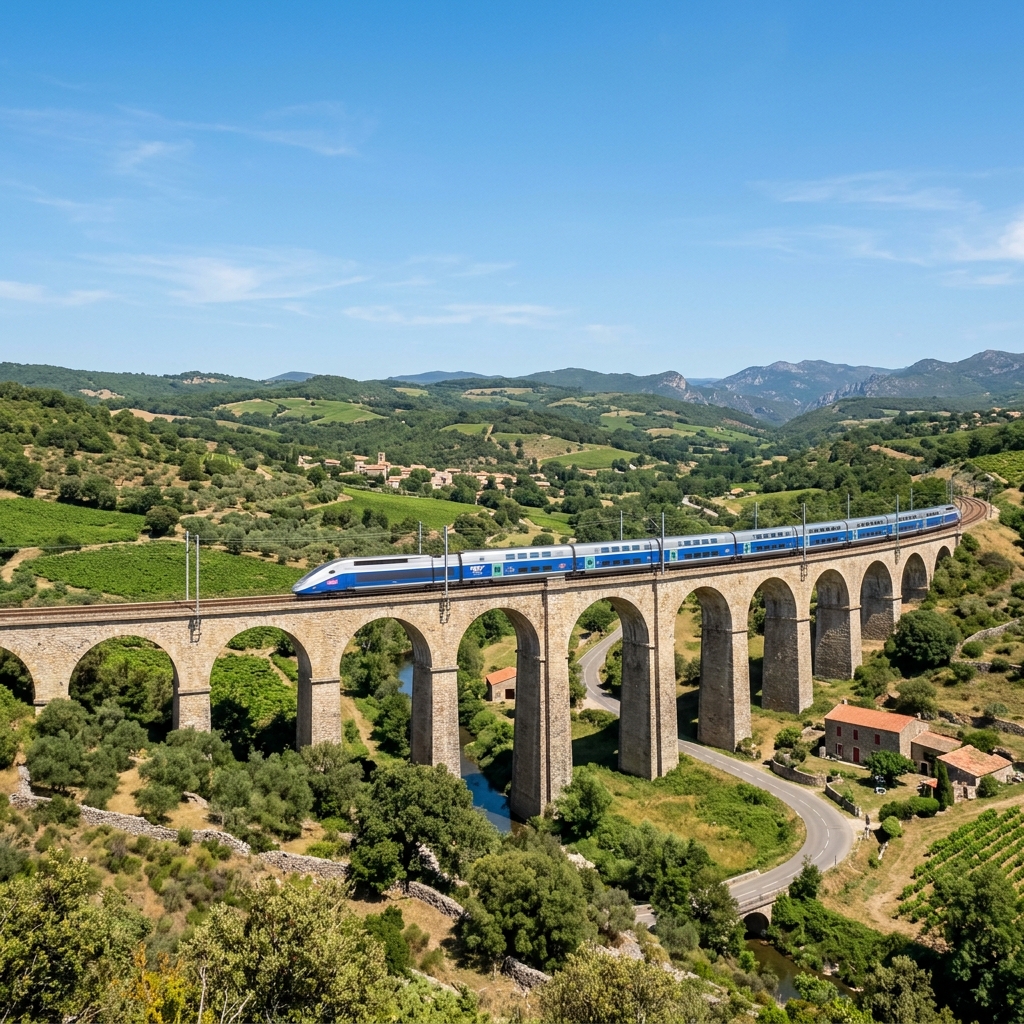
The direct high-speed service from Paris Gare de Lyon to Barcelona Sants runs through the south of France and along the Mediterranean coast before crossing the border via the Figueres tunnel. The Languedoc section, roughly Montpellier to Perpignan, offers coastal views that justify the window seat.
This replaced what used to be an awkward journey requiring a change at the border. Now it’s a single train, operated jointly by SNCF and Renfe, with fares starting around 39 euros if booked early. The 6-hour-30-minute journey is competitive with flying once you factor in airport transfers and security. Our Paris to Barcelona guide has full booking details.
2. London to Amsterdam, Eurostar (3h 52min)
Eurostar’s direct service from London St Pancras to Amsterdam Centraal runs through the Channel Tunnel and across Belgium without stopping. Three hours and fifty-two minutes, city centre to city centre. The equivalent flight takes about an hour in the air but three to four hours door to door once you include Heathrow or Schiphol transfers.
The Dutch countryside section, flat, green, punctuated by canals and church spires, is unremarkable but pleasant. The real advantage is arriving in central Amsterdam without having seen an airport. Fares from 40 pounds. Full route guide here.
3. Munich to Venice, EuroCity (6h 30min)
This is one of the most scenically spectacular direct routes in Europe. The EuroCity service from München Hauptbahnhof to Venezia Santa Lucia crosses the Brenner Pass through the Austrian Alps, descends through the Tyrol, and arrives in Venice, a city you should approach by train if you can approach it by train.
The Austrian section is the highlight: the Inn Valley, the climb to the Brenner, the descent into Italy through the Dolomite foothills. Bring food, the journey is long enough to warrant it but not long enough to be tedious. Our guide to Milan to Venice covers the Italian portion.
4. Zürich to Zagreb, Direct Day Train (14h)
One of Europe’s great marathon direct services. The ÖBB train from Zürich runs through Liechtenstein (technically), Austria, Slovenia, and into Croatia, four countries, no changes. The Alpine section through the Arlberg Pass and the Slovenian approach to Ljubljana are both excellent.
Fourteen hours is a commitment, but it’s a remarkably civilised one. Austrian trains are comfortable, the scenery shifts dramatically every few hours, and you arrive in Zagreb having seen a genuine cross-section of Central Europe. Pair with our Zagreb guide.
5. Paris to Milan, TGV (7h)
The TGV Lyria service runs direct from Paris Gare de Lyon to Milano Centrale through the Alps. The Burgundy vineyards give way to the Jura, then the train enters Switzerland briefly before the long descent into the Po Valley. Not the fastest way to reach Milan, but the most comfortable, and the scenery through eastern France is quietly beautiful.
Fares start around 29 euros booked well in advance. Our guide to Rome to Milan covers onward connections from Milan into Italy’s rail network.
6. Copenhagen to Stockholm, SJ High-Speed (5h 10min)
The direct SJ service crosses the Øresund Bridge, one of Europe’s great engineering feats, connecting Denmark to Sweden across 16 km of open water, and then runs north through the Swedish countryside to Stockholm Central. The bridge crossing alone is worth the ticket.
Five hours and ten minutes. Flat, forested, occasionally coastal. The Swedish section is contemplative rather than dramatic, which suits the pace. Fares from around 199 SEK (roughly 18 euros) booked early. Full route details.
7. Berlin to Prague, EuroCity (4h 20min)
The EuroCity from Berlin Hauptbahnhof to Praha hlavní nádraží runs through Saxon Switzerland, a field of sandstone pillars, deep gorges, and forested plateaus along the Elbe River. The section between Bad Schandau and Děčín, where the train follows the Elbe through the Bohemian-Saxon borderlands, is one of the most underrated stretches of scenic rail in Central Europe.
No reservation required on most services. Walk on with any valid ticket. Our Prague by train guide covers the city end. See also Prague to Berlin.
8. Barcelona to Madrid, AVE (2h 30min)
Spain’s AVE high-speed network is genuinely impressive. The direct service between Barcelona Sants and Madrid Atocha covers 620 km in two and a half hours through the arid meseta of central Spain. The field is austere, ochre plains, distant mountains, occasional villages, but the speed and smoothness of the train make it a pleasure.
Renfe fares start at 18 euros with Promo tickets. Our Barcelona to Madrid guide has booking tips.
9. Vienna to Venice, Nightjet (11h, overnight)
ÖBB’s Nightjet sleeper service runs direct from Wien Hauptbahnhof to Venezia Santa Lucia. You board in the evening, sleep through the Alps, and wake up approaching Venice across the Lagoon. There are few better ways to arrive anywhere.
Couchette berths start around 30 euros; private sleeper compartments from about 90 euros. The service runs via Villach and Udine. Pair with our Vienna guide and night trains in Europe.
10. Lisbon to Porto, Alfa Pendular (2h 40min)
Portugal’s flagship tilting train runs direct between Lisbon Santa Apolónia and Porto Campanhã. The route follows the Atlantic coast for stretches, particularly around Coimbra, and the Portuguese countryside is green and unpretentious. The train leans into curves rather than slowing for them, which gives a faintly nautical quality to the ride.
Fares from around 20 euros in comfort class. Our Lisbon to Porto guide has the full picture.
11. Amsterdam to Berlin, ICE Direct (6h 20min)
The direct ICE service runs from Amsterdam Centraal through the Netherlands, across the German border, and into Berlin Hauptbahnhof. The Dutch section is predictably flat; the German section becomes gradually more interesting as you approach Berlin through Brandenburg.
No reservation required on German ICE trains, just board with a valid ticket. Sparpreis fares from 17.90 euros booked 90 days ahead.
12. Milan to Rome, Frecciarossa (2h 55min)
Trenitalia’s flagship high-speed service covers the 570 km between Milano Centrale and Roma Termini in under three hours. The train runs at up to 300 km/h through the Apennine mountains via a series of tunnels, less scenic than slower alternatives, but effortlessly fast.
Fares from 19.90 euros with Super Economy tickets. Our Milan to Rome guide covers everything. From Rome, connect to Naples or Florence.
13. Brussels to London, Eurostar (2h)
Two hours from Bruxelles-Midi to London St Pancras via the Channel Tunnel. Completely painless. The Belgian countryside section is brief; the Kent countryside on the English side is gentle. The point is not the scenery, it’s the extraordinary convenience of arriving in central London from central Brussels in less time than most domestic flights take door to door.
Fares from 39 euros one way. See also our Paris to Brussels guide.
14. Stockholm to Narvik, Arctic Circle Train (19h)
Sweden’s SJ night train runs from Stockholm through the boreal forests of northern Sweden, crosses the Arctic Circle, and terminates in Narvik, Norway, a town on a fjord above the 68th parallel. In winter, there’s a chance of seeing the northern lights from your sleeper berth. In summer, the midnight sun means it never gets dark.
This is one of Europe’s great adventures. It requires patience and an appreciation for emptiness, the field north of Umeå is forests, lakes, and not much else for hundreds of kilometres. Fares from around 400 SEK (roughly 36 euros) for a seat.
15. Budapest to Bucharest, Direct Sleeper (14h)
The overnight train from Budapest Keleti to Bucharest Nord runs across the Hungarian plain, through the Transylvanian Carpathians, and into Romania’s capital. The mountain section, if you’re awake for it, is dramatic. The border crossing procedures add a certain atmosphere that more polished routes lack.
This is old-school European rail travel: slow, slightly unpredictable, and deeply satisfying. Pair with our Budapest by train guide.
How to Find Direct Trains
The most reliable tools for finding direct European train services:
Deutsche Bahn (bahn.de): The best general journey planner in Europe. Use the “Only direct connections” filter to exclude routes with changes. Works for trains in most European countries, not just Germany.
Trainline: Good for booking across multiple operators. Filter results by “Direct only” after searching.
Individual operator websites: For specific countries, the national operator’s site often has better availability and lower prices. SNCF for France, Renfe for Spain, Trenitalia for Italy, SBB for Switzerland, ÖBB for Austria.
Eurail/Interrail planner: If you’re using a pass, the official planner shows direct options and indicates which require reservations. Our rail pass guide explains pass strategy in detail.
Tips for Direct Long-Distance Trains
Book early for the best fares. Yield pricing means the first tickets sold are the cheapest. For high-speed direct services, 60-90 days ahead is the sweet spot. Our guide to saving money on European trains covers this in depth.
Bring food and water. Direct trains over four hours will have some kind of catering, but it’s often expensive and limited. A good sandwich, some fruit, and a bottle of water make a six-hour journey significantly more pleasant.
Choose your seat side wisely. On scenic routes, Munich to Venice, Berlin to Prague, Copenhagen to Stockholm, the side of the train matters. Research which side offers the best views for your direction of travel.
Consider first class on longer routes. The price difference on many European direct trains is 10-20 euros. On a seven-hour journey, wider seats, more legroom, and a quieter carriage are worth the upgrade. Our eating on trains guide covers what to expect for onboard dining.
Check whether a reservation is mandatory. Some direct trains (TGV, AVE, Eurostar, Frecciarossa) require reservations. Others (most DB ICE, Austrian ÖBB, Swiss SBB) don’t. This affects flexibility, unreserved trains mean you can change your plans on the day.
Frequently Asked Questions
See the FAQ section above for the most common questions about direct European train travel. For broader planning advice, see how to book European trains and our complete Europe by train guide.