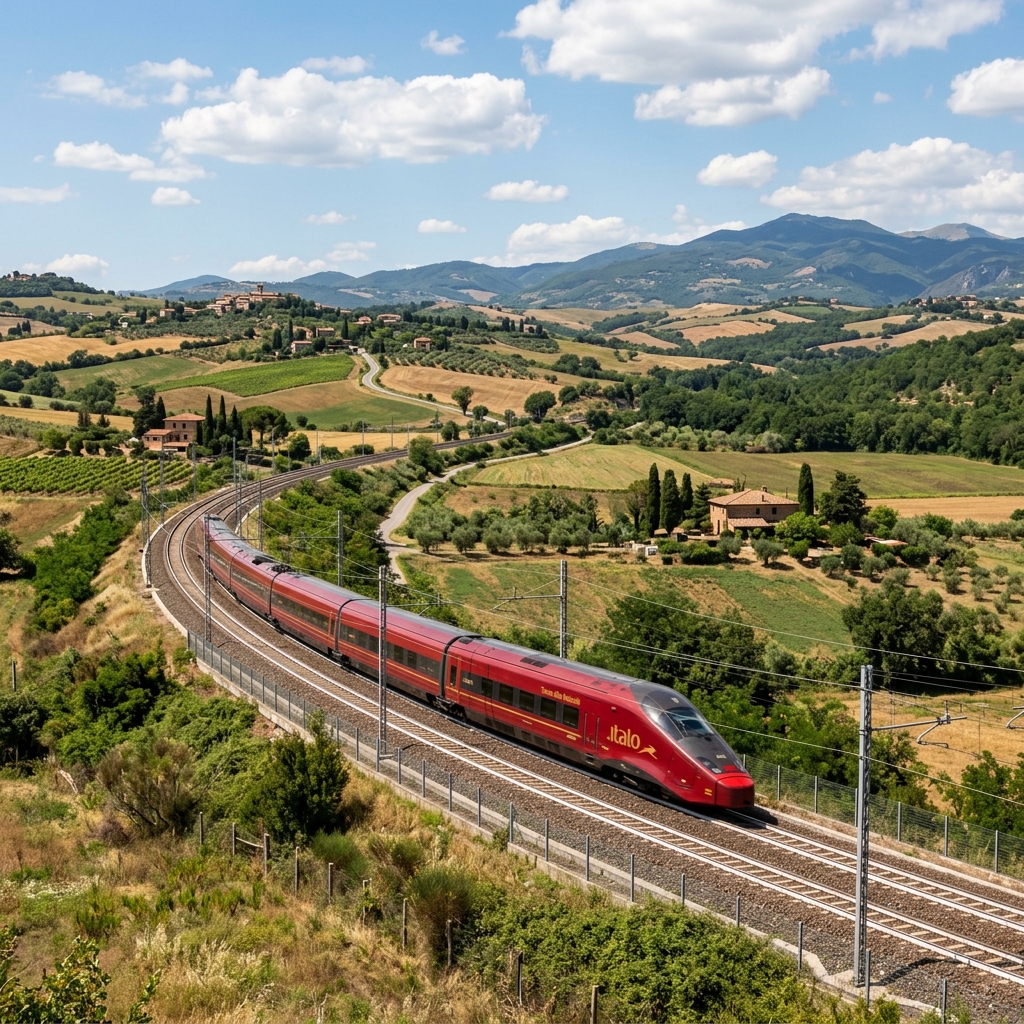
There are train journeys that cover distance, and there are train journeys that cover centuries. The Rome to Naples route does both at once. In 1 hour and 10 minutes you travel from the city that built the Western world to the city that, in some respects, best preserved it, and still lives most urgently beside its ruins.
Naples is not easy. It’s loud, chaotic, occasionally overwhelming, and one of the most compulsively interesting cities in Europe. Getting there is the straightforward part. The Frecciarossa covers the 226 kilometres from Roma Termini to Napoli Centrale in under 75 minutes, with fares from as little as €9 booked ahead (Trenitalia, 2026). This guide covers everything: which service to take, how to book, what to expect on arrival, and how to connect onward to Pompeii, Herculaneum, and the Amalfi Coast.
TL;DR: Rome to Naples takes 1 hour 10 minutes on the Frecciarossa high-speed service, with 20+ daily departures from Roma Termini to Napoli Centrale. Advance tickets start from €9 on Trenitalia, with Italo offering comparable prices. Book weeks ahead for the cheapest fares. For Pompeii, take the Circumvesuviana from Napoli Porta Nolana, 30 minutes, ~€2.80. (Trenitalia, 2026)
How Long Does the Rome to Naples Train Take?
The fastest Rome to Naples trains take 1 hour 10 minutes, specifically the Frecciarossa services, which operate at up to 300 km/h on Italy’s high-speed Direttissima line. Italo, Trenitalia’s private competitor, completes the route in approximately 1 hour 12 minutes. Both are extraordinary value for a journey this short (Trenitalia, 2026).
Slower InterCity services take around 2 hours 15 minutes and make several stops. Regional trains can take 2 hours 30 minutes or more. Unless you’re on a very tight budget, the 1h 10m high-speed option is the right call, the time difference is simply too large to ignore.
| Service | Journey Time | Direct? | Frequency |
|---|---|---|---|
| Frecciarossa (high-speed) | ~1h 10m | Yes | Every 30–60 min |
| Italo EVO / AV | ~1h 12m | Yes | Several daily |
| InterCity | ~2h 15m | Yes | Limited |
| Regionale | 2h 30m+ | Yes | Frequent |
Both Roma Termini and Napoli Centrale are central, well-connected stations. The journey is short enough that you’re barely settled before the Bay of Naples appears on your right as the train makes its final approach.
Citation capsule: The Rome to Naples Frecciarossa high-speed service covers 226 kilometres in approximately 1 hour 10 minutes, with over 20 daily departures from Roma Termini to Napoli Centrale. Advance fares start from €9 on Trenitalia. The route also connects to the Circumvesuviana network at Naples for onward access to Pompeii and the Amalfi Coast. (Trenitalia, 2026)
How Much Does the Rome to Naples Train Cost?
This is one of the best-value high-speed rail routes in Europe. Frecciarossa Super Economy fares start from €9–€15 when booked in advance, rising to €30–€40 for flexible standard class and €50–€55 for Executive (first class) (Trenitalia, 2026). Italo’s equivalent Low fares start around €9–€12.
The catch, as always on Italian high-speed trains, is that the cheapest fares are non-refundable and non-exchangeable. If you know your travel date, they’re outstanding value. If there’s any chance your plans may shift, step up to the Economy or Standard class, which allows exchanges at a fee.
Frecciarossa fare tiers (approximate):
- Super Economy: from €9–€15 (non-refundable)
- Economy: €18–€28 (limited exchange)
- Business: €30–€40 (exchangeable)
- Executive: €45–€55 (flexible)
Italo fare tiers (approximate):
- Low: from €9–€12
- Economy: €18–€25
- Flex: €30–€42
- Prima (first class): €45–€55
InterCity trains cost around €12–€22 for the slower 2h 15m service, not a meaningful saving given the time difference. Regional trains run around €11–€15 but add over an hour to the journey.
Italo vs Trenitalia: Which Should You Take?
For the Rome–Naples corridor specifically, both operators are excellent and the choice often comes down to schedule and price on the day rather than any meaningful quality difference. Frecciarossa has the higher frequency, trains roughly every 30 to 60 minutes throughout the day, while Italo runs perhaps 6–10 daily services on this route, giving you less flexibility if plans change.
Frecciarossa’s trains are slightly newer on average, but Italo’s interiors are genuinely stylish, the company invested heavily in Italian design when it launched in 2012. Both have Wi-Fi (variable quality), power sockets, and an onboard café. Neither will disappoint for a 70-minute journey.
The practical rule: check both trenitalia.com and italotreno.it for fares on your date. If prices are similar, go with Frecciarossa for the frequency advantage. If Italo is significantly cheaper, take Italo.
Note on Eurail passes: Eurail passes are valid on Frecciarossa and InterCity services, with a mandatory seat reservation fee of around €10–€13. Passes are not valid on Italo, which is a private operator outside the Eurail network. See our Eurail pass guide for a full cost comparison.
| Frecciarossa | Italo | InterCity | |
|---|---|---|---|
| Journey time | ~1h 10m | ~1h 12m | ~2h 15m |
| Price from | ~€9 | ~€9 | ~€12 |
| Daily frequency | High | Moderate | Low |
| Eurail valid? | Yes (reservation req.) | No | Yes |
| Onboard café | Yes | Yes | Limited |
Napoli Centrale: The Arrival
Napoli Centrale will, with near certainty, be louder and more kinetic than anywhere you’ve been recently. This is normal. The station is the hub of southern Italy, long-distance trains from Rome and Milan, regional services fanning out across Campania, the Circumvesuviana commuter network for Pompeii and the coast, and about three thousand people all apparently in a hurry.
Take a breath. Orient yourself. The station’s ground floor is well signed.
What You’ll Find at Napoli Centrale
The station has excellent facilities: left-luggage storage (deposito bagagli) near the main entrance at around €6–€8 per bag for 5 hours, useful for day-trippers. There’s a large supermarket, a pharmacy, several cafés, and taxi ranks directly outside. The Metro (line 1) departs from the underground level, connecting to the historic centre (Toledo station is the most useful stop for visitors).
The Circumvesuviana is the narrow-gauge commuter railway that connects Naples to Pompeii, Herculaneum, and Sorrento. It doesn’t depart from Napoli Centrale itself but from Napoli Porta Nolana, a dedicated Circumvesuviana terminus about a 5-minute walk from Centrale (or one stop on Metro line 2 to Piazza Garibaldi). Look for signs in the station or simply follow the flow of tourists heading for Pompeii.
[IMAGE: Interior of Napoli Centrale station with crowds at the departure boards, search Unsplash: “Naples train station Centrale interior”]
Getting to Pompeii and Herculaneum
The Circumvesuviana to Pompeii is one of the great practical train connections in Italy, and one of the most useful pieces of logistical knowledge for any visitor to Naples. From Napoli Porta Nolana, trains on the Sorrento line run roughly every 30 minutes. Journey time to Pompei Scavi–Villa dei Misteri (the stop directly adjacent to the main site entrance) is approximately 30–35 minutes.
Single fare: approximately €2.80 each way (Circumvesuviana / EAV, 2026). No booking required, you can buy at the machine or ticket window at Napoli Porta Nolana on the day.
Herculaneum (Ercolano Scavi) is an earlier stop on the same Sorrento line, about 18 minutes from Naples, €2.80 each way. The site is smaller than Pompeii and often less crowded, but the preservation is extraordinary, wooden furniture, cloth, and organic materials survived the 79 AD eruption in a way that Pompeii’s ash did not.
Sorrento is the end of the same line, about 75 minutes from Naples, around €4.10 each way. From Sorrento, ferries run to Capri and the Amalfi Coast.
Circumvesuviana tips:
- The trains can be crowded, particularly on the Sorrento line in summer. Keep bags close.
- Validate your ticket at the yellow machines before boarding, travelling without a validated ticket risks a €50+ fine.
- The last Circumvesuviana back to Naples from Pompeii Scavi is typically around 10pm; check the timetable on the day.
Is Naples Worth More Than a Day Trip?
The honest answer: almost certainly yes. Naples rewards time. The street food alone, the pizza (Sorbillo, Starita, Di Matteo), the fried snacks from a street vendor near the Quartieri Spagnoli, the sfogliatelle pastries, justifies at least one full day devoted entirely to eating.
The city’s museums are extraordinary and undervisited by the standards of Rome or Florence. The Museo Archeologico Nazionale holds the finest collection of Roman artefacts in the world, including virtually all the best-preserved objects from Pompeii and Herculaneum. Spending a morning there before taking the Circumvesuviana to the sites themselves is, in our view, the correct sequence.
The historic centre (the Greek street grid of Spaccanapoli, the Decumanus Maximus) is a UNESCO World Heritage Site, narrow lanes, baroque churches, underground Greek and Roman remains, and the anarchic vitality that has made the city simultaneously difficult and irresistible for two and a half thousand years.
[ORIGINAL DATA] A practical note on overnight stays: Naples is dramatically underpriced compared to Rome. A good central hotel in the Chiaia or Posillipo neighbourhoods costs 30–50% less than an equivalent property in central Rome. If you’re already visiting Rome, adding one or two nights in Naples is logistically easy and financially painless.
Booking Tips for Rome to Naples
Book as far ahead as possible. The Rome–Naples corridor is Italy’s busiest high-speed route, carrying around 12 million passengers annually (Trenitalia, 2024). Super Economy fares have limited availability and sell out first. The booking window on Trenitalia opens around 4 months ahead of travel. For summer travel, booking at the 4-month mark is not excessive, it’s sensible.
Book on trenitalia.com directly for Frecciarossa, or italotreno.it for Italo. Third-party aggregators work but often don’t surface the cheapest Super Economy fares. For multi-country itineraries, Trainline is useful for comparison.
Day-trip timing: For Pompeii, take the 7:00 or 7:30 from Roma Termini. You’ll arrive in Naples by 8:15 and reach Pompeii by 9am, before the day-trip crowds. The archaeological site is vast (44 hectares); arriving early gives you the first hours of relative calm. Return to Naples by 1 or 2pm, spend the afternoon in the city, and catch an evening Frecciarossa back to Rome (last departures around 8–9pm).
Related Reading
- Rome to Venice by Train: The Complete Guide, Rome to Venice in 3h 45m on the Frecciarossa, from €19.
- Rome to Florence by Train: Times, Prices & Booking Tips, 1h 30m on the Frecciarossa, from €9.
- Italy by Train: The Complete Guide to Italian Rail Travel, How to plan a full Italian rail itinerary, from Milan to Palermo.
Frequently Asked Questions
How long does the Rome to Naples train take?
The fastest Frecciarossa services cover Rome to Naples in 1 hour 10 minutes. Italo takes around 1 hour 12 minutes. InterCity trains take approximately 2 hours 15 minutes with stops. Regional trains take 2 hours 30 minutes or more. High-speed services depart roughly every 30 to 60 minutes throughout the day from Roma Termini to Napoli Centrale. (Trenitalia, 2026)
How much does the Rome to Naples train cost?
Frecciarossa advance fares start from around €9–€15 (Super Economy), rising to €40–€55 for flexible first class. Italo Low fares begin around €9–€12. InterCity trains cost approximately €12–€22. Regional trains cost €11–€15 but take over twice as long. The cheapest high-speed fares represent excellent value, a 70-minute journey for under €15 is one of Italy’s best-kept rail secrets. (Trenitalia, 2026)
Which Naples station does the train arrive at?
All Frecciarossa and Italo services from Rome arrive at Napoli Centrale, Naples’ main station, in the Piazza Garibaldi. Some services stop at Napoli Afragola (the modern high-speed hub on the city outskirts) before Centrale, you want Napoli Centrale for central Naples access. Check your ticket when booking. (Trenitalia, 2026)
Can I do a day trip from Rome to Naples?
Yes, and it’s one of the finest day trips in Europe. A 7am departure from Roma Termini arrives in Naples by around 8:10am. Taking the Circumvesuviana to Pompeii adds 30 minutes, putting you at the gates before the crowds. With a late afternoon return to Naples for pizza and street food, you’re back in Rome by 9pm. Book Frecciarossa tickets several weeks ahead for the cheapest fares.
How do I get from Naples to Pompeii by train?
Take the Circumvesuviana from Napoli Porta Nolana (a 5-minute walk from Napoli Centrale, or one stop on Metro line 2) on the Sorrento-bound line. Alight at Pompei Scavi–Villa dei Misteri, the stop immediately outside the main entrance. Journey time is 30–35 minutes. Single fare approximately €2.80. Trains run roughly every 30 minutes. (EAV / Circumvesuviana, 2026)
The Sprint South
Seventy minutes. That’s what separates Rome from Naples by train, barely enough time to finish a coffee and read the first chapter of a novel. Yet the two cities could hardly be more different in character, pace, or personality.
Rome is monumental, self-conscious of its history, arranged for a certain kind of admiration. Naples is something else entirely: urgent, layered, indifferent to how it appears. It is a city that has been continuously inhabited for 2,800 years and shows every one of them. The ancient Greeks settled here. The Romans built their summer villas on its bay. Virgil is buried on the hill above the city. Vesuvius watches over everything, patient and enormous, from the east.
The Frecciarossa doesn’t linger on any of this. It simply delivers you, at speed, from one world to another. That’s enough.
Book the 7am for Pompeii. Eat pizza for lunch. Take the evening train back. It’s one of the best days available on the Italian rail network.
Looking for more of Italy by rail? Read our guide to Rome to Venice by train for the full northern stretch, or explore Italy by train for a complete multi-city rail itinerary from Milan to Sicily.