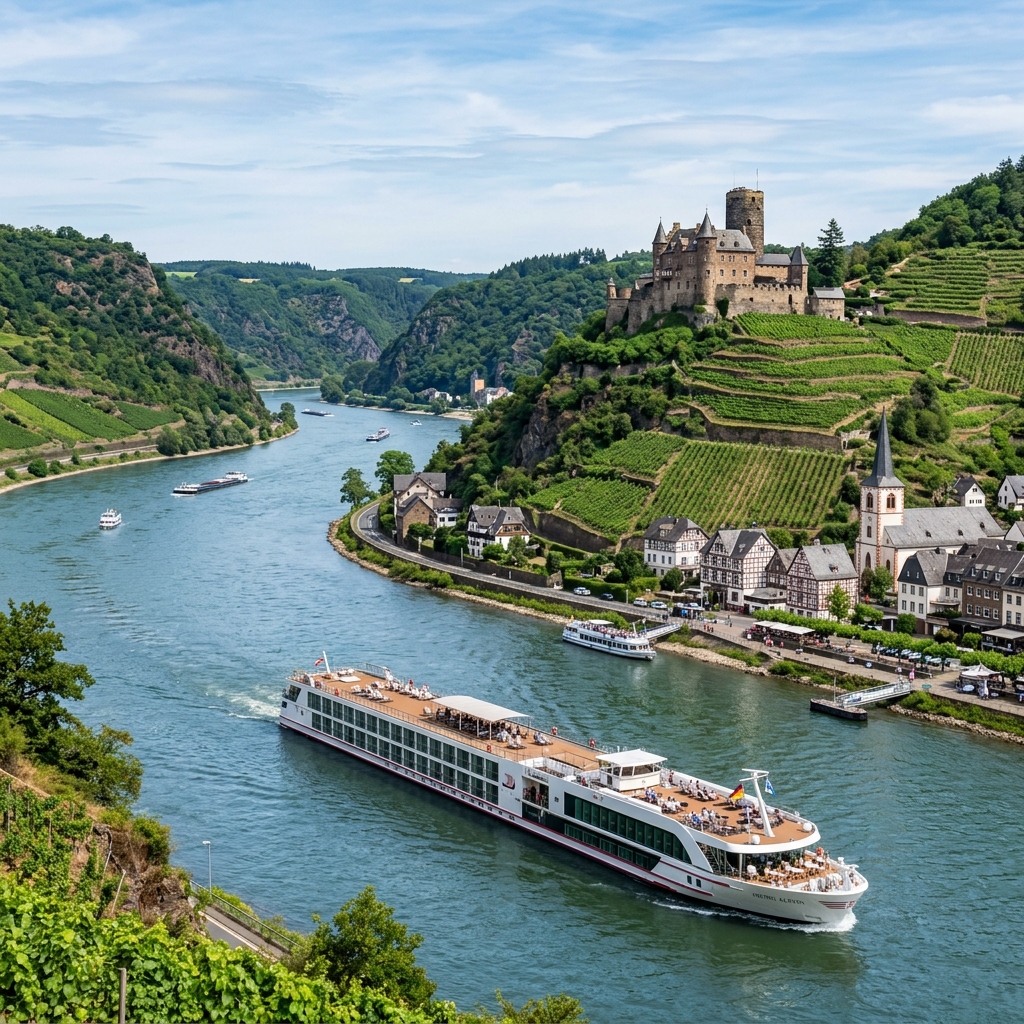
River travel has a particular quality that no other form of transport quite matches. You board once, unpack your bag, and for the next seven days the world slides past your window like a slow documentary — vineyard-covered slopes, medieval fortresses, cathedral spires appearing around each bend. You eat and sleep in the same place each night. There is no queue at the airport, no hauling luggage across unfamiliar platforms, no decision fatigue about where to eat. The Rhine river cruise is, in many ways, the purest expression of slow travel available to the modern traveler.
This guide covers everything you need to know: the route, the operators, how to get there by train, what to expect on board, and — for those who want the scenery without the price tag — a genuine budget alternative that follows the exact same river for a fraction of the cost.
The Rhine Route: Basel to Amsterdam
The classic Rhine cruise runs approximately 1,000 kilometres from Basel in Switzerland northward through Germany and the Netherlands to Amsterdam (or in reverse, which is equally common). The journey typically takes 7–8 days, though some operators offer shorter 4–5 day variations focusing on the most dramatic sections.
The key stops along the route:
Basel, Switzerland — The starting point for most southbound cruises and the ending point for northbound ones. Basel sits at the junction of Switzerland, France, and Germany (the so-called Dreiländereck, or Three Countries Corner). It rewards a pre-cruise day: the old town, the Kunstmuseum, and the Rhine swimming culture (locals float downstream on the current in waterproof bags — a genuine Basel tradition in summer) are all worth your time.
Strasbourg, France — The first major French stop, Strasbourg straddles the border between France and Germany in every sense: the half-timbered Petite France district looks Germanic, the cathedral is Gothic French, the food merges choucroute with Riesling. Shore excursions here typically include the historic centre and the European Parliament quarter.
Heidelberg, Germany — One of the Rhine cruise’s most popular excursions. The actual cruise ships dock at Mannheim (where the Neckar meets the Rhine), and coaches transfer passengers to Heidelberg, whose ruined red-sandstone castle above the old town is one of Germany’s most romantic sights. The walk up through the Schlossgarten takes 20 minutes and the views over the river valley are worth it.
The Rhine Gorge: Bingen to Koblenz — This is why you came. The 65-kilometre stretch between Bingen and Koblenz is a UNESCO World Heritage Site and the visual centrepiece of any Rhine cruise. Steep slate hillsides rise directly from the water on both banks, terraced with Riesling and Spätburgunder vines. Every few kilometres a medieval castle appears on a promontory — there are more than 40 castles and castle ruins in this section alone. The Loreley rock, where according to legend a siren lured boatmen to their deaths on the rocks, sits at the narrowest point. Ships often time their passage through the Gorge for late afternoon, when the light is golden and passengers gather on the sun deck.
Koblenz — Where the Moselle joins the Rhine at the Deutsches Eck (German Corner), with its enormous equestrian statue of Kaiser Wilhelm I. The citadel on the east bank (Festung Ehrenbreitstein) is reachable by cable car and offers panoramic views over both river valleys.
Cologne — The Rhine’s most significant city. The twin-spired Gothic cathedral, begun in 1248 and completed 632 years later, dominates the skyline and sits directly beside the main train station — one of the great urban arrivals in Europe. Most cruises offer a half-day here; if you have more time, the Chocolate Museum (surprisingly good) and the Romano-Germanic Museum are both worth visiting.
Amsterdam — The northern terminus. For most passengers, Amsterdam represents either the end of the cruise or the beginning of a pre-cruise stay. The city is one of Europe’s most walkable and cyclable capitals, and two or three days here — canal houses, the Rijksmuseum, the Anne Frank House, the Jordaan neighbourhood — is time genuinely well spent.
The Rhine Gorge in Detail
The section between Bingen and Koblenz deserves its own attention. This is one of the most densely layered landscapes in Europe: every hill has a castle, every village has a wine estate, every bend in the river reveals another scene that could serve as a Romantic painting.
The castles are genuinely extraordinary. Burg Rheinstein, Gutenfels, the Pfalzgrafenstein (a toll castle built on a tiny island in the middle of the river in 1326), Marksburg (the only Rhine castle never destroyed or significantly rebuilt — the real thing), Sterrenberg and Liebenstein (the “feuding brothers” castles), Stolzenfels, Lahneck. Most cruises include at least one castle visit as a shore excursion; Marksburg is the most worthwhile.
The wine villages — Bacharach, Boppard, Oberwesel, St Goar, Braubach — are each small enough to walk in an hour but rewarding enough to justify an afternoon. The local Riesling is dry, mineral, and completely different from the sweet Riesling most people have encountered in supermarkets. A glass at a Weinstube terrace overlooking the river costs €4–6.
Rhine River Cruise Operators and Prices
Viking River Cruises — The dominant operator on European rivers, Viking is the choice for travelers who want a reliable, premium experience with good English-language commentary and a largely American/Canadian/Australian passenger base. Their Rhine itineraries run €3,500–€5,500 per person for 8 days, including all meals, shore excursions, and a flight credit. The ships are modern, the cabins are well-designed, and the included wine with dinner is genuinely good. Book 12–18 months ahead for the best prices.
AmaWaterways — Slightly more luxurious than Viking, with a stronger culinary focus (cooking demonstrations, more elaborate menus) and a notably attentive service style. Prices run €4,000–€6,000 per person. AmaWaterways also caters well to cyclists — most ships carry bikes and the Rhine towpath routes are excellent.
Avalon Waterways — A mid-range option (€2,500–€4,000) that offers good value without sacrificing quality. The ships have panoramic “open-air” cabin designs (large sliding-glass walls rather than small portholes) that are particularly good for the Rhine Gorge passage.
Scenic — Australian-owned and premium-priced (€4,500–€7,000), Scenic operates what are effectively floating boutique hotels. All shore excursions are included (no optional extras to pay for), and the level of personalisation is higher than most competitors.
Emerald Cruises — The budget-friendly sibling of Scenic, Emerald offers a very similar product at roughly half the price (€2,000–€3,500). An excellent choice for first-time river cruisers who want to try the format without committing to top-tier prices.
What’s typically included: All meals and most drinks (wine/beer with dinner at minimum, full open bar on premium ships), all shore excursions, all port fees and taxes, on-board entertainment and lectures, bicycles for use at ports, Wi-Fi. Flights are sometimes included on promotional fares but more often are a separate purchase.
What to watch for: Solo supplements (usually 30–60% extra — look for operators who occasionally waive them), optional shore excursions not included in base price, gratuities (typically €12–15 per person per day, sometimes included).
Getting to the Rhine by Train
The Rhine is one of the most rail-accessible cruising destinations in the world. Both embarkation points — Basel and Amsterdam — are major international rail hubs.
To Basel:
- From Paris Gare de Lyon: TGV direct, 3 hours, from €29 booked ahead
- From Zurich HB: 45 minutes by ICE or Swiss InterCity, from CHF 32
- From Frankfurt: 2 hours 40 minutes by ICE, from €29
- From London: Eurostar to Paris (2h20m) + TGV to Basel (3h), total journey under 6 hours
To Amsterdam Centraal:
- From London St Pancras: Eurostar direct, 3 hours 52 minutes, from £39
- From Brussels Midi: Thalys/Eurostar, 1 hour 50 minutes, from €29
- From Paris Gare du Nord: Thalys, 3 hours 20 minutes, from €29
- From Frankfurt: ICE direct, 3 hours 45 minutes, from €49
Both cities are also easily reachable from most German cities by ICE — Cologne, Munich, Berlin, Hamburg all have direct or single-change connections to either endpoint. For passengers arriving in Germany for their cruise, using the train rather than a rental car or airport transfer is usually cheaper, faster, and dramatically less stressful.
What to Expect on Board
Rhine cruise ships are purpose-built for river navigation: long, narrow, and low-profile (they need to pass under bridges with limited clearance, particularly on the Gorge section). Most ships carry 130–190 passengers — small enough to feel personal, large enough for good amenities.
Cabins: Standard cabins on modern river cruise ships are typically 16–18 square metres with a French balcony (floor-to-ceiling sliding doors that open to a railing but no outdoor space). Upper-deck suites on premium ships have proper walk-out balconies. The difference between a lower-deck inside cabin and an upper-deck suite is significant — if you’re paying for the Rhine scenery, consider budgeting for at least a French balcony cabin.
Dining: All meals are included on all Rhine cruise operators. Dinner is typically a three-course or four-course meal with regional dishes (Sauerbraten in Germany, choucroute in Alsace, Dutch herrings in Amsterdam). Quality ranges from solid to excellent depending on the operator. Most ships have an al fresco dining option on the top deck during good weather.
Shore excursions: Included excursions are typically city walking tours with a local guide — informative and well-paced but sometimes slow if you’re an experienced traveler. Most ships also offer “active” alternatives (cycling, hiking) and independent exploration time. If you’d rather skip the group tour and wander alone, this is always an option.
The sun deck: The social heart of any river cruise. The Rhine Gorge passage, castle sightings, and major arrivals are all best experienced from the top deck. Bring a layer — it can be cold on the water even in summer.
Best Time for a Rhine River Cruise
May–June: The optimal window for most travelers. Holland is in full tulip bloom during April–May (technically before most Rhine cruises begin in earnest, but late May still catches flowers). The Rhine Gorge is vivid green, temperatures are pleasant (18–24°C), and the summer crowds haven’t fully arrived. This is also the best time for cycling excursions.
September–October: Wine harvest season on the Rhine. Riesling grapes are harvested in late September and October, and many riverside villages hold Weinfeste (wine festivals) during this period. The foliage turns gold and red. Temperatures drop but rarely uncomfortably — expect 14–20°C. River levels are reliably navigable (summer droughts occasionally affect river levels in July–August, which can disrupt itineraries).
Christmas Markets (late November–December): A genuinely magical option that has grown hugely popular. Cologne, Strasbourg, Heidelberg, and Koblenz all have famous Christmas markets, and cruise operators run dedicated market itineraries. It is cold (0–8°C) and the Gorge landscape is bare, but the atmosphere of candlelit markets, mulled wine, and cathedral silhouettes is hard to match.
July–August: Peak season — highest prices, most crowded ports. The weather is excellent (25–32°C) and the experience is wonderful, but book early and expect to pay a premium.
The Budget Alternative: KD Rhine Boats and Regional Rail
A Rhine river cruise is wonderful, but it is not the only way to experience the Rhine. For budget-conscious slow travelers, the independent approach offers the same scenery for a fraction of the cost — and arguably more freedom.
KD Rhine Line (Köln-Düsseldorfer) has operated scheduled passenger boats on the Rhine since 1827. Their boats run between Cologne and Mainz with stops at every significant village in the Rhine Gorge. A day pass costs around €49 and allows you to hop on and off at any stop. This is genuinely excellent value — you get the full river experience, the Gorge passage, the castle views, and the freedom to spend three hours in Bacharach before catching the next boat downstream.
Combine with regional rail: Every Rhine Gorge village has a train station (the rail line runs along both banks). You can travel upstream by boat and downstream by train (or vice versa), stopping wherever takes your fancy. A Rhineland-Palatinate day ticket (€29 for regional trains) or the Germany €49 monthly ticket makes this extremely affordable.
Where to stay in the Gorge: Bacharach (perhaps the most atmospheric village, excellent guesthouses from €40/night), Boppard (larger, good facilities), St Goar (across from the Loreley, castle hotel options). Staying in the villages rather than cities dramatically changes the experience — you have the riverside to yourself in the evenings after the day-trippers leave.
The self-guided approach works best for independent travelers comfortable with a degree of flexibility. The cruise suits those who want everything arranged, no logistical decisions, and the social atmosphere of a floating hotel.
Combining a Rhine Cruise with Train Travel
One of the great advantages of the Rhine as a slow travel destination is how naturally it integrates with European rail travel. Consider these combinations:
The grand European arc: London → Paris (Eurostar, 2h20m) → Basel (TGV, 3h) → Rhine cruise to Amsterdam → Amsterdam (Eurostar, 3h52m) → London. This is a genuinely great two-week holiday with minimal flying and maximal scenery.
The city pairing: Fly into Zurich or Paris, take the train to Basel, cruise to Amsterdam or Cologne, and continue by rail to Amsterdam to Paris train or onwards into Germany. The Rhine slots naturally into a longer European rail itinerary.
Germany by rail extension: After disembarking in Cologne or Amsterdam, a Germany by train trip through Hamburg, Berlin, Dresden, and Munich makes for a logical and satisfying continuation.
Practical Details
Booking timeline: 12–18 months ahead for best cabin selection and lowest prices on premium operators. Last-minute deals (4–8 weeks out) do appear but cabin choice is limited. Solo travelers should watch for “no single supplement” promotions, which most operators run at least once a year.
Packing: River cruise ships have a relaxed dress code — smart casual for dinner is the norm, no formal nights (unlike ocean cruises). Layers are important; the sun deck is cold at night even in summer. Pack comfortable walking shoes for shore excursions on cobbled streets.
River levels: A genuine concern. The Rhine, particularly in the Gorge section, can drop to levels that prevent normal navigation during dry summers. Most operators offer itinerary substitutions (usually a coach transfer around the low-water section), but it is worth checking the operator’s low-water policy before booking.
Gratuities: Budget €12–15 per person per day (total, not per staff member). Many operators now include gratuities in the published price — check before departure.
The Rhine river cruise is, at its best, one of the finest slow travel experiences in Europe: a week of being moved through an extraordinarily beautiful landscape with almost no effort required of you. The scenery does the work. The history piles up outside your window. The Riesling is cold. There is very little that needs improving.