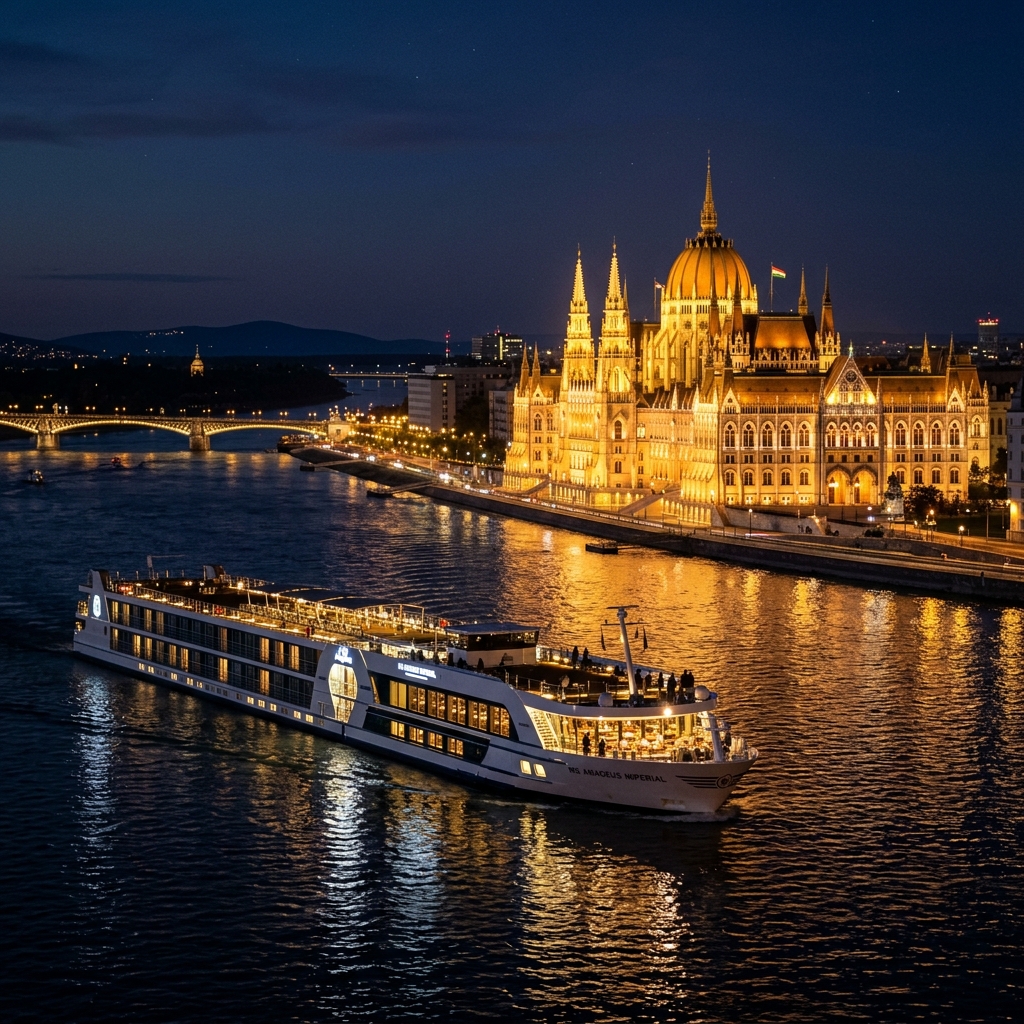
The Danube is Europe’s second-longest river, and the section from Passau to Budapest passes through more concentrated cultural history than almost any other stretch of navigable water on the continent. In eight days on the river you cross four countries, pass through two imperial capitals, slide under medieval fortifications, and watch central Europe’s most dramatic gorge unfold around you. It is an exceptional slow travel experience — and one that pairs naturally with the train network that connects these same cities.
This guide covers the classic route, the operators, how to arrive by rail, why Vienna deserves more than a port stop, the overlooked charm of Bratislava, and the spectacular extended route to the Iron Gates and the Black Sea.
The Classic Route: Passau to Budapest
Most Danube cruises begin in either Nuremberg (with a coach transfer to the embarkation point) or Passau, the small Bavarian city where the Inn, Ilz, and Danube rivers meet. The downstream journey takes approximately 7 days to reach Budapest.
Passau — The embarkation point deserves at least an afternoon. The old town sits on a narrow peninsula between the Danube and the Inn, and the Baroque St Stephen’s Cathedral contains the world’s largest cathedral organ (17,774 pipes). It is also a genuinely pretty small city that most cruise passengers rush through on their way to the boat.
Regensburg — One of the few German cities to emerge from the Second World War almost completely intact, Regensburg has a medieval core that is entirely UNESCO-listed. The Stone Bridge, built in 1146, is still in use. The Historische Wurstkuchl sausage kitchen beside the bridge has been operating since the 12th century — an outdoor lunch there, with a Radler and a view over the Danube, is one of Germany’s authentic pleasures.
Linz, Austria — The Austrian city most visitors skip, Linz has transformed itself over the past 20 years into a credible contemporary arts destination. The Ars Electronica Center (museum of the digital future, unusual and genuinely interesting) and the Lentos modern art museum on the Danube bank are the main draws. Linz is also where Hitler spent his formative years — the Documentation Center at the site of the planned “Führermuseum” is one of the more thoughtful memorial sites in Austria.
Vienna — The Habsburg capital and the visual and cultural climax of the upper Danube section. Ships dock at the Reichsbrücke in the Donau City district — a 20-minute tram ride from the Innere Stadt (first district). Most cruise itineraries allow 1–1.5 days here, which is not enough. More on Vienna below.
Bratislava, Slovakia — Typically a 4–6 hour stop. More on why this deserves more time below.
Budapest, Hungary — The end point of the classic cruise, and one of Europe’s most dramatically beautiful cities. The Danube here is at its grandest: the Parliament building on the Pest bank, the Royal Palace on the Buda hill, the Chain Bridge connecting them, the Fishermen’s Bastion above. Arriving by river rather than by air or train gives you the full panorama.
Getting There by Train
To Passau:
- Munich Hauptbahnhof to Passau: 1 hour 30 minutes by direct regional express (RE), €20–25
- Vienna to Passau: 3 hours by Railjet to Salzburg, then regional train, or direct coach
To Vienna (for fly-cruise or pre-cruise arrival):
- Munich to Vienna: 4 hours by Railjet, from €19 booked ahead
- Budapest to Vienna: 2 hours 30 minutes by Railjet — one of Europe’s great train journeys, running alongside the Danube for much of the route, from €19
- Prague to Vienna: 4 hours by Railjet, from €19
- Zurich to Vienna: 8 hours with one change, scenic through the Alps
- London to Vienna: Eurostar to Brussels (2h), ICE to Frankfurt (1h50m), Railjet to Vienna (6h30m) — a full day’s travel but entirely feasible and satisfying
To Budapest (for reverse or post-cruise):
- Vienna to Budapest: 2 hours 30 minutes by Railjet, from €19
- Prague to Budapest: 7 hours, one change
- Bucharest to Budapest: overnight train available
The Munich to Vienna train is a particularly good option for passengers flying into Munich and positioning for a Passau embarkation — you can do Munich sightseeing, take the evening train to Passau (1h30m), and board the ship the next morning.
Vienna: Why Two Extra Days Are Non-Negotiable
Vienna rewards time. The city was the capital of an empire that stretched from Brussels to Bucharest, and it spent 600 years accumulating art, architecture, and culinary culture at a scale that makes even a week feel rushed. Most Danube cruises give you a day. That is not enough.
Two days in Vienna before or after your cruise transforms the trip. Here is why:
The Kunsthistorisches Museum contains one of the greatest collections of Old Master paintings in the world — Vermeer, Caravaggio, Rembrandt, Velázquez, the entire Northern Renaissance. Allow three hours minimum; it will probably be four.
The coffee houses are a UNESCO-listed cultural tradition. Café Central (grand, touristy but still magnificent), Café Hawelka (small, literary, unchanged since 1939), Café Landtmann (Vienna’s most elegant) — sitting for two hours over a Melange and a slice of Sachertorte with a newspaper is not indulgence, it is participating in a living institution.
Schönbrunn Palace — 1,441 rooms and 40 hectares of formal gardens. The palace tour itself takes 90 minutes; the gardens and the Gloriette hilltop pavilion take another two hours and reward the effort with views over the entire city.
The Vienna State Opera offers standing room tickets for €4–13. Check the schedule before you travel — a standing room slot at the Staatsoper is one of the great cheap cultural experiences in the world.
Naschmarkt — Vienna’s open-air market, stretching for 600 metres along the Linke Wienzeile. Döner stands, Austrian delicatessens, spice vendors, fish stalls, antique dealers. Go on Saturday morning when the flea market section is also running.
The Vienna slow travel guide covers accommodation and neighbourhood logistics in detail. For the Danube cruise passenger, the Innere Stadt (1st district) or Neubau (7th district) are the most convenient bases.
Bratislava: The Overlooked Stop
Bratislava has a reputation problem. For decades it was treated as an afterthought on the Danube itinerary — a brief stop between Vienna and Budapest, overshadowed by its more famous neighbours. That reputation is outdated.
The old town is compact, architecturally coherent, and almost entirely car-free. The main square (Hlavné námestie) is lovely; the narrow lanes around it contain independent coffee shops, good Slovak restaurants, and almost no tourist tat. The castle (Bratislava Hrad) sits on a hill above the river and offers wide views over the Danube plain, including the old communist-era bridge with its distinctive UFO-shaped restaurant at the top of the pylon (the UFO restaurant is genuinely fun, and the observation platform is free with a meal booking).
Prices are significantly lower than Vienna or Budapest. A three-course lunch at a good Slovak restaurant costs €12–16. Beer in a bar costs €1.50–2.50. This makes Bratislava a refreshing stop after Vienna, and an argument for staying a night rather than treating it as a transit point.
Getting to Bratislava independently: Vienna to Bratislava takes 1 hour by direct train (€12–18) or 1.5 hours by the Twin City Liner high-speed catamaran along the Danube (€35, but significantly more scenic). Bratislava is also just 65 kilometres from Vienna Airport — cruise passengers flying home from Vienna can spend a full day in Bratislava before catching a train to the airport.
The Extended Route: Budapest to the Black Sea
The classic cruise ends in Budapest, but the Danube continues for another 1,500 kilometres through Serbia, Romania, Bulgaria, and Moldova before reaching the Black Sea. The extended route is for a different type of traveler — one who finds the heavily touristed Vienna-Budapest section a little too comfortable.
Belgrade, Serbia — A gritty, fascinating city that has been destroyed and rebuilt more times than any other European capital. The confluence of the Danube and Sava rivers at Kalemegdan Fortress is spectacular. Belgrade’s restaurant and nightlife scene is outstanding and extremely cheap by western European standards.
Iron Gates Gorge (Đerdap) — The centrepiece of the extended route. The Danube narrows dramatically as it cuts through the last spur of the Carpathian Mountains, forming a gorge that stretches 100 kilometres along the Serbian-Romanian border. The rock face on the Serbian bank bears a 40-metre carved portrait of the Dacian king Decebalus, commissioned by a Romanian businessman and completed in 2004 — absurd and magnificent. The ruins of Trajan’s Bridge, built by the Romans in 105 AD to cross the Danube during the conquest of Dacia, are visible from the water at Drobeta-Turnu Severin.
Cruising beyond the Iron Gates requires a 12–15 day itinerary — either a full Passau-to-Black Sea cruise (rare and expensive, €6,000–€12,000) or a fly-cruise starting in Budapest or Belgrade. Operators who run this route include Viking, Tauck, and Scenic.
Danube Cruise Operators
Viking River Cruises — Market leader on the Danube as on the Rhine. Reliable, well-organized, strongly English-speaking passenger base. Prices €3,000–€5,500 for 8 days. Viking has a particularly good Budapest excursion programme, including a Hungarian cooking class and an evening concert at a city palace.
AmaWaterways — Culinary focus, attentive service, strong wine programme (the Danube passes through several wine regions including the Wachau in Austria, home to excellent Grüner Veltliner). Prices €3,500–€6,000.
Tauck — Premium all-inclusive operator with notably small passenger numbers (maximum 130) and a high staff-to-guest ratio. All excursions and gratuities included with no optional add-ons. Prices €5,000–€8,000 — expensive, but the all-in nature means fewer surprises.
Avalon Waterways — Mid-range, good value, open-air cabin design. Prices €2,200–€4,000.
Scenic — Ultra-premium Australian operator. “Freechoice” excursions (you pick what interests you rather than following the group). Prices €4,500–€7,000. The ship design and on-board experience are genuinely outstanding.
Emerald Cruises — Scenic’s budget-friendly sibling, same destinations and similar itineraries at lower prices (€2,000–€3,500). The best starting point for first-time river cruisers who want to test the format.
Best Time for a Danube Cruise
April–May: Lower crowds, lower prices, spring colours in the Wachau (apricot blossom in April is a Wachau landmark — the valley produces both excellent wine and apricots). Weather is mild (14–22°C) and reliable.
September–October: Wine harvest in the Wachau and Burgenland wine regions. The Danube autumn is golden and spectacular. Vienna’s concert season begins in September, making cultural add-ons more interesting.
June–August: Peak season. Reliable warm weather (25–35°C in Budapest in July), but higher prices and busier ports. River levels can drop in drought years — check the operator’s contingency policies.
Christmas Markets: Vienna, Bratislava, Budapest, and Regensburg all have famous Christmas markets. Late November and December cruises are popular but cold (−5 to 8°C) — pack for it.
The Budget Alternative: Mahart Ferry and Rail
For travelers who want the Danube scenery without the cruise price, the Mahart ferry between Budapest and Vienna offers the same river views for approximately €35 one-way. The journey takes 5–6 hours downstream (Budapest to Vienna) or 6–7 hours upstream, with a stop in Bratislava. It is a day-long journey rather than a week-long one, but the Danube Bend section north of Budapest — where the river carves a dramatic 90-degree turn through forested hills — is genuinely beautiful.
Alternatively, the combination of the Budapest slow travel guide for a slow 5-day stay in Budapest, the train to Vienna (2h30m), and the Vienna slow travel guide for another 4 days captures most of the cultural content of the cruise at a fraction of the price. You just don’t have the river itself as your accommodation.
Practical Considerations
Solo travelers: The Danube cruise demographic skews toward couples aged 55–75. Solo travelers are welcome but will pay a solo supplement (typically 30–60% on standard cabins). Viking, AmaWaterways, and Emerald each run periodic “no single supplement” promotions — worth monitoring if you’re traveling alone.
Wachau Valley: The 36-kilometre stretch between Melk and Krems in Austria is to the Danube what the Rhine Gorge is to the Rhine — the most dramatic and beautiful section, with steep terraced vineyards, apricot orchards, Baroque monasteries (Melk Abbey above the river is magnificent), and medieval villages. This section is typically passed during daytime so passengers can be on deck.
Currency: Euros in Austria, Bratislava, and Germany. Hungarian Forint in Budapest — most tourist businesses accept euros but the exchange rate is poor; use a no-fee card or withdraw local currency at an ATM. Serbian Dinar on extended cruises.
Tipping: Budget €12–15 per person per day for staff gratuities. Check whether this is included in your fare.
The Danube cruise is, for many travelers, their introduction to river cruising — and it converts almost everyone. The combination of scenery, history, cities, and genuine cultural depth is unmatched on any other European river. Vienna alone is worth the trip.