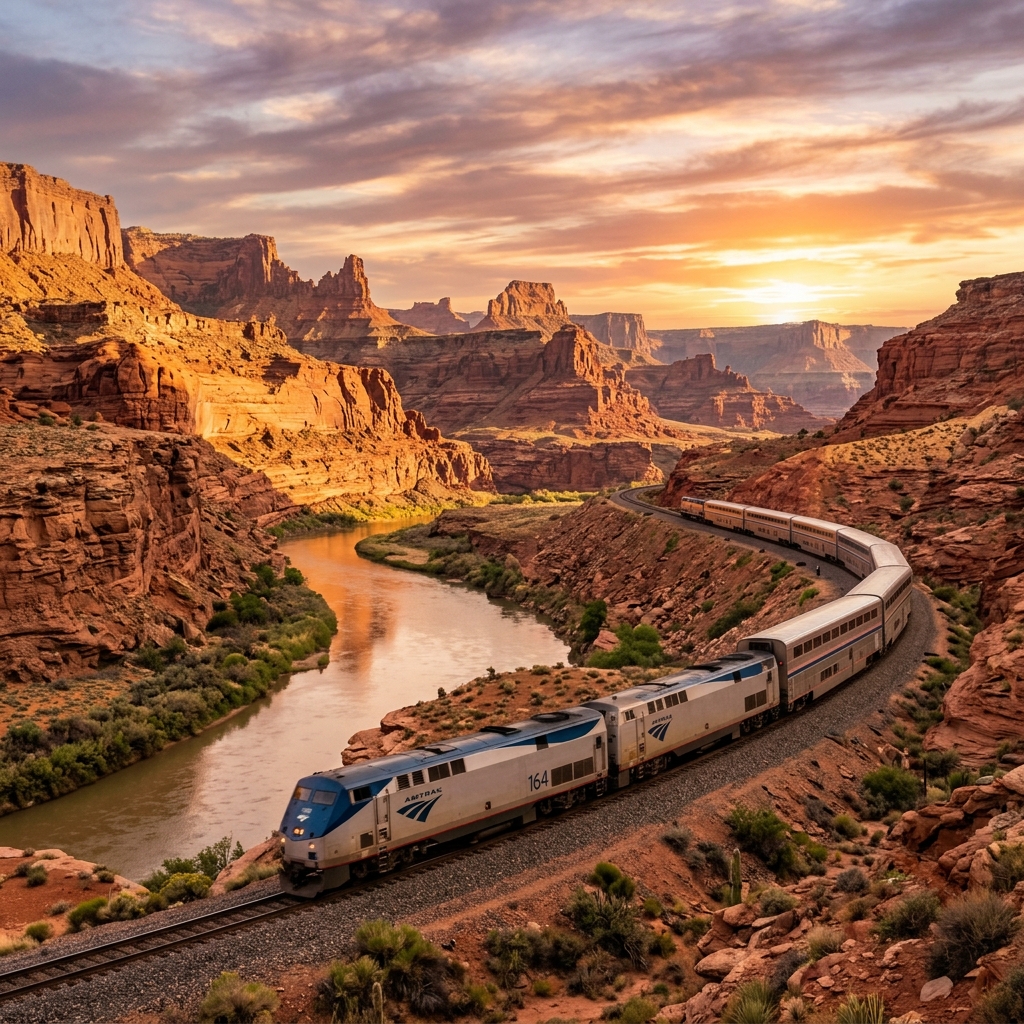
America has a complicated relationship with its passenger trains. Congress created Amtrak in 1971 precisely because private railroads had stopped caring whether their passenger services survived. The freight railroads that inherited the tracks kept them, and kept the legal right-of-way that means an Amtrak train must yield when a Union Pacific freight decides it needs the same piece of track. That’s why long-distance Amtrak trains run late. It’s structural, not accidental.
And yet the trains are worth taking. Not despite their slowness, but partly because of it. A flight from Chicago to San Francisco takes five hours and shows you the cloud layer. The California Zephyr takes fifty-one hours and shows you Nebraska, the Rockies, Glenwood Canyon, the salt flats of Utah, and the Sierra Nevada in the final afternoon. These are not equivalent experiences. One transports you. The other travels with you. If you already plan trips the slow, overland way, American rail is the deepest version of that idea available anywhere in North America.
What follows is a guide to the routes that justify the case for American rail: the trains that show you the continent rather than passing over it.
TL;DR: The USA’s best scenic train routes, the California Zephyr, Empire Builder, Coast Starlight, and Southwest Chief, together cover more than 8,000 miles of American landscape that no aircraft can show you. Amtrak carried a record 32 million-plus passengers in FY2024 (Amtrak). Sleeper accommodation sells out months ahead on popular summer departures; book at Amtrak.com as early as you can.
The Routes at a Glance
| Route | Miles | Scheduled time | Signature highlight |
|---|---|---|---|
| California Zephyr | 2,438 | ~51 hours | Glenwood Canyon and the Sierra Nevada |
| Southwest Chief | 2,265 | ~40 hours | New Mexico high desert and red-rock Arizona |
| Empire Builder | 2,206 | ~46 hours | Glacier Country and the Columbia River Gorge |
| Coast Starlight | 1,377 | ~35 hours | The Cascades, Mount Shasta, and the Gaviota coast |
| Cardinal | 1,147 | ~27 hours | The New River Gorge in West Virginia |
Distances and scheduled times are drawn from Amtrak’s published timetables (Amtrak); treat them as planning figures, since run times flex with freight congestion and season.
The California Zephyr: Chicago to San Francisco
The California Zephyr covers 2,438 miles in approximately 51 hours across seven states, making it the longest and most scenically varied single train journey in the United States (Amtrak). No other Amtrak route compresses so many distinct American landscapes into one continuous experience. This is the train you take when you want to understand what lies between the coasts, and it deserves (and has) its own deep-dive guide.
The route divides into four acts, each with its own character. Nebraska’s plains run mostly overnight for westbound passengers, which is, honestly, convenient. The Rockies begin arriving around Denver and build for seven hours through Gore Canyon and then Glenwood Canyon. Utah brings desert and salt flats. The Sierra Nevada closes the journey with a four-hour mountain descent into the Bay Area.
Glenwood Canyon: Where Everyone Stops Talking
Glenwood Canyon is the twelve-mile section of the journey, roughly near Glenwood Springs, Colorado, where the train enters a vertical-walled canyon above the Colorado River. The canyon walls rise 1,300 feet. The river runs alongside the track the entire length. It took 12 years and roughly $490 million to build the interstate highway through this canyon (Colorado Department of Transportation); the railroad has been there since 1887. When the canyon begins, even the most phone-absorbed passengers put their screens down. That detail shows up in traveller account after traveller account, and it is the single best argument for the whole route.
Best Seats, and Roomette vs Coach
For westbound travel, the left (south-facing) side of the train positions you toward the Colorado River in Glenwood Canyon and the canyon walls, rather than the hillside. Request this when booking a roomette. For the Sightseer Lounge, the glass-walled observation car open to all passengers, arrive 20 to 30 minutes before the canyon section begins and you will find a window seat.
The roomette question for a 51-hour train is not really a question. Coach seats are wide and recline more generously than any airline seat; they are tolerable for a night. For two nights, the calculus changes. The roomette costs more but includes all meals in the dining car, three courses at a proper table, with strangers who become, over the course of Colorado and Utah, briefly fascinating. Across the owner reviews and long-form ride reports synthesized here, that social dimension is the most consistently cited highlight of the train. If you are weighing it seriously, the full roomette guide breaks down the math.
Citation Capsule: The California Zephyr runs daily between Chicago Union Station and Emeryville, California (with a connecting bus into San Francisco), a distance of 2,438 miles across Illinois, Iowa, Nebraska, Colorado, Utah, Nevada, and California. The scheduled westbound journey time is roughly 51 hours. Coach fares start around $60 to $150; roomettes run $200 to $600 and up per person, including all meals (Amtrak).
The Empire Builder: Chicago to Seattle and Portland
The Empire Builder covers 2,206 miles on a route that splits at Spokane, Washington, one branch continuing to Seattle, the other to Portland, an unusual bifurcation among Amtrak’s long-distance trains (Amtrak). At approximately 46 hours, it’s a day shorter than the Zephyr. For many riders it is the more dramatic train, and it has a complete guide of its own.
The case for the Empire Builder is Montana. The train crosses the state for most of a day, east to west through the Hi-Line, the flat agricultural strip below the Rocky Mountain Front, with the mountains appearing first as a smear on the horizon and slowly resolving into the Rockies’ northern face. Havre, Montana, at dawn is one of those peculiar Amtrak moments travellers describe again and again: a small-city station in the early light, cattle country in every direction, the mountains not yet visible. It’s unglamorous, and it is exactly the point.
Glacier Country and the Columbia River Gorge
The stretch through Glacier Country, where the train runs along the southern boundary of Glacier National Park before descending through the mountains to Whitefish, is the Empire Builder’s headline moment. The mountains here are built from rock far older than the central Rockies further south, which gives them a different character: broader, more rounded, cut through by glacial valleys that open suddenly from the train window.
The Portland branch descends the Columbia River Gorge in the final hours before arrival. The gorge is about 80 miles long and up to 4,000 feet deep, carved by the Columbia River through the Cascade Range. In autumn, this section has a quality of light, the river flat and wide, the walls changing colour, that regular riders say justifies the entire journey.
Dining Car Culture on the Empire Builder
The Empire Builder has long represented Amtrak dining at its most American. Seating in the dining car is communal: you sit with whoever the attendant directs you toward, a practice that produces conversations you would never engineer deliberately. Read enough ride reports and the cast of characters becomes a genre: retired schoolteachers from Minnesota, a couple relocating to Portland, a man who has ridden the Builder every year for twenty years and can’t quite explain why he keeps coming back. This is the social dimension of American rail travel that has no European equivalent, and it is the part sleeper passengers write about most. European trains are transport. The Empire Builder, at its best, is a moving community.
Citation Capsule: The Empire Builder (Amtrak trains 7/8 and 27/28) runs daily between Chicago Union Station and Seattle King Street Station / Portland Union Station, covering 2,206 miles in approximately 46 hours through Wisconsin, Minnesota, North Dakota, Montana, Idaho, and Washington/Oregon. It is consistently one of Amtrak’s highest-ridership long-distance routes (Amtrak).
The Coast Starlight: Seattle to Los Angeles
The Coast Starlight runs 1,377 miles between Seattle and Los Angeles in approximately 35 hours, making it the shortest of the major transcontinental Amtrak journeys and, mile for mile, one of the most geographically rich (Amtrak). There is a full guide to the Coast Starlight elsewhere on this site; the short version is that “coast,” as on many American trains, requires some interpretive generosity, but the middle of the route over-delivers.
The train runs through the Cascades in Oregon, traversing volcanic terrain along a long ridge of peaks. Mount Shasta appears in the distance as the train crosses into California: 14,179 feet, snowcapped most of the year, visible for over an hour from the eastern side of the train. The Central Valley of California is agricultural and flat, less conventionally scenic, but the Sierra Nevada is visible to the east throughout, a hundred miles of mountains hanging in the air above the farmland. Between San Luis Obispo and Ventura the line finally reaches actual ocean along the Gaviota coast, one of the few places in the Amtrak network where the Pacific is right outside the window.
The Parlour Car, and What Replaced It
For decades the Coast Starlight’s signature was the Pacific Parlour Car, a vintage lounge for sleeping-car passengers with wine tastings, afternoon tea, and evening films. Amtrak retired those heritage cars in 2018, so ignore any guide that still promises them. The current experience centres on the standard Superliner Sightseer Lounge and the scenery itself, with sleeper-class perks varying by season and year, which is a good reason to check current onboard amenities at booking rather than trusting summaries, including this one.
Citation Capsule: The Coast Starlight (trains 11/14) runs daily between Seattle King Street Station and Los Angeles Union Station, covering 1,377 miles in approximately 35 hours through Washington, Oregon, and California (Amtrak).
The Southwest Chief: Chicago to Los Angeles
The Southwest Chief is the Zephyr’s southern rival: 2,265 miles in roughly 40 hours from Chicago to Los Angeles via Kansas City, Albuquerque, and Flagstaff (Amtrak). Where the Zephyr is a mountain train, the Chief is a desert one. After the plains of Kansas, it climbs Raton Pass into New Mexico, then spends a full afternoon in the high desert along the Rio Grande valley around Albuquerque, with the Sandia Mountains standing over the city. Arizona brings the Navajo Nation and the red-rock country around Flagstaff, where the San Francisco Peaks appear on the horizon, before the long descent into the California desert and the San Bernardino mountains.
Riders consistently single out two moments: the Raton Pass climb, where the train works visibly hard and the plains drop away behind you, and the evening approach to Flagstaff, when the red rock holds the last light. As with all Amtrak sleepers, the roomette includes meals, and the Chief’s dining car is one of the more sociable thanks to its mix of rail enthusiasts, Navajo Nation commuters, and retirees doing the full Chicago-to-LA run.
The Cardinal: New York to Chicago, the Sleeper Value Secret
The Cardinal is the connoisseur’s pick: 1,147 miles from New York to Chicago in about 27 hours, running three days a week via Washington, D.C., Virginia horse country, and West Virginia (Amtrak). Its centrepiece is the New River Gorge, where the train follows the river through the canyon that is now a national park, one of the most underrated scenic stretches in the entire Amtrak network. The crossing of the Alleghenies around White Sulphur Springs adds dense Appalachian ridgeline that the faster, flatter Lake Shore Limited skips entirely.
Because the Cardinal is a secondary train with modest demand, its Viewliner roomettes often cost less than equivalent accommodation on the marquee routes, which makes it the cheapest practical way to sample American sleeper travel. The tradeoffs are real: three-day-a-week service means planning around the schedule, and run times are padded. The full Cardinal guide covers the routing and booking tactics in detail.
Booking, Delays, and Expectations
A few practical realities shape every trip on this list, and knowing them in advance is the difference between a good experience and a ruined one.
Book sleepers early. All Amtrak trains require reservations, including coach seats, and the booking window typically opens around 11 months out at Amtrak.com. Roomettes and bedrooms on summer departures of the Zephyr, Empire Builder, and Chief sell out months in advance. If your dates are fixed, book the sleeper first and the flights second.
Assume delays. In FY2023, only about 40% of long-distance trains arrived within 15 minutes of schedule (Amtrak), largely because Amtrak shares tracks with freight railroads that have legal priority. Build a minimum three-hour buffer into any connection, and never book a same-day flight out of the arrival city. Treat delays as part of the rhythm rather than a failure; the journeys are worth taking despite them.
Consider a rail pass if you’re chaining routes. Amtrak’s USA Rail Pass lets you string multiple long-distance segments together, and for an itinerary like Zephyr-plus-Chief it can undercut point-to-point pricing. The USA Rail Pass analysis runs the numbers on when it pays off.
Pack like it’s a small hotel, not a flight. Checked baggage allowances on long-distance trains are generous, but you’ll live out of your bag for two or three days in a moving room; the carry-on packing list for international travel translates well to rail trips. One reference worth carrying is the long-running Bradt guide USA by Rail, which has covered this network across decades of editions (see the current edition on Amazon).
Frequently Asked Questions
What is the most scenic Amtrak train route in the USA?
The California Zephyr (Chicago to San Francisco via the Rockies and Sierra Nevada) is widely considered the most scenically varied long-distance train in the USA: 2,438 miles across seven states, with Glenwood Canyon, the Colorado Rockies, the Nevada desert, and the Sierra Nevada in the final hours. The Empire Builder, through Montana’s Glacier Country, is the consistent runner-up in rider surveys and guidebook rankings.
How much does an Amtrak long-distance train ticket cost?
Coach seats on cross-country routes commonly start in the $60 to $150 range booked well ahead, per Amtrak’s fare listings (Amtrak). Roomettes (private cabin with meals included) typically run $200 to $600 and up for the same journey, and larger bedrooms cost more. Prices swing hard with season and demand, so treat any figure, including these, as a planning range rather than a quote.
Are Amtrak trains reliable?
Not reliably on time. In FY2023, only about 40% of long-distance trains arrived within 15 minutes of schedule (Amtrak), largely because Amtrak shares tracks with freight railroads that have legal priority. Build a minimum three-hour buffer into any connection and the delays become a scheduling detail rather than a crisis.
Is a roomette worth it on Amtrak?
For journeys over about 12 hours, most repeat riders say yes without hesitation. The roomette includes all dining-car meals, the fold-down beds are comfortable enough for a full night’s sleep, and the large picture windows make the landscape available in a way coach cannot match. On a 51-hour train like the California Zephyr, a roomette is less a luxury than the correct way to take the trip.
Do you need a reservation on Amtrak?
Yes, all Amtrak trains require reservations, including coach seats, booked at Amtrak.com or through the Amtrak app. The booking window opens roughly 11 months in advance for most routes. For sleeper accommodation on summer departures, book as early as possible; popular routes sell out months ahead.
Where to Go Next
If this list has you hooked on the idea that trains are a destination rather than a delivery mechanism, two directions reward further reading: the 15 best train journeys in the world places these American routes in global context, and the scenic trains of Switzerland beyond the Glacier Express shows what the same idea looks like in the country that does it best.
Affiliate disclosure: This page contains an affiliate link. If you buy through it, we may earn a small commission at no extra cost to you, and it never affects what we recommend.