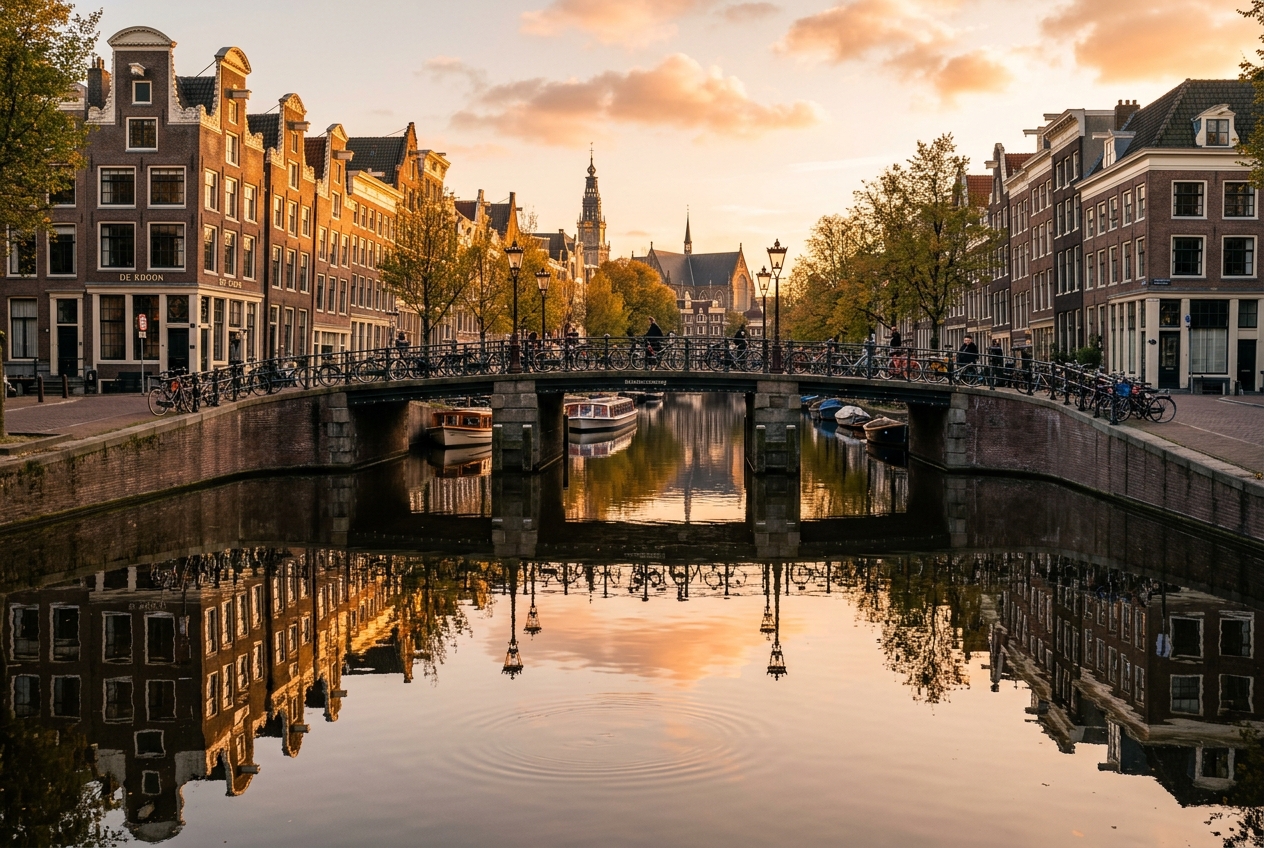
Most people come to Amsterdam for two or three days. They do the Anne Frank House, the Rijksmuseum, a canal boat, a bicycle wobble along the Prinsengracht, and then they leave, photographs secured, box ticked, city filed. That’s a perfectly reasonable way to spend a long weekend. This guide is not for those people.
Amsterdam is one of a small number of European cities that reveal themselves almost entirely in the third, fourth, and fifth day of a stay. The canal ring, a UNESCO World Heritage Site since 2010, is not a set of monuments. It’s a neighbourhood that people cycle through on their way to work, hang their washing above, and argue about planning permissions for. The city’s residents between them hold more than 150 nationalities, and it is simultaneously one of the world’s most visited cities and one of the most genuinely inhabited. The tourists pass through; the city carries on regardless.
A week here isn’t self-indulgent. It’s the minimum needed to stop sightseeing and start paying attention. The wider case for travelling this way — fewer places, longer stays, lower daily burn — is laid out in our slow traveller’s guide to budget travel in Europe; Amsterdam is simply where the argument is easiest to prove.
TL;DR: Amsterdam’s UNESCO-listed canal ring, cycling culture, and genuinely inhabited centre make it one of Europe’s best slow travel cities, but only if you stay long enough to stop being a tourist. Seven nights, an apartment in the Jordaan or De Pijp, a rented bicycle, and no itinerary after 2pm is the formula. Amsterdam receives 22 million visitors a year (Amsterdam & Partners, 2025); almost none of them actually arrive.
Why Does Amsterdam Reward Slow Travel?
Amsterdam’s 17th-century canal ring, the Grachtengordel, was inscribed as a UNESCO World Heritage Site in 2010 (UNESCO, 2010), making it one of the most significant planned urban landscapes in the world. But unlike most heritage sites, it’s still entirely inhabited. People live, work, cycle, and park their boats along the same streets that were laid out in the Dutch Golden Age. That combination of historical density and continued daily life is what makes Amsterdam worth slowing down for.
The city has a geographical quality that rewards walking pace. It’s small — you can cross the historic core on foot in well under an hour — but extraordinarily layered. Each canal ring adds a different character: the inner Singel, the grander Herengracht, the quieter Keizersgracht, the residential Prinsengracht. The streets connecting them contain, in compact succession, a 17th-century hofje (almshouse garden), a corner shop selling Indonesian spices, a gallery showing contemporary photography, and a café where the walls have been brown for the better part of a century.
What the tourism numbers don’t tell you: Amsterdam received 22 million visitors in 2024 (Amsterdam & Partners, 2025), against a resident population of roughly 921,000 (Gemeente Amsterdam, 2024) — more than twenty visitors per resident, every year. But the visitors concentrate intensely in a few square kilometres around Centraal station, the Rijksmuseum, and the Leidseplein. Walk 15 minutes south into De Pijp or 10 minutes west into the Jordaan and the crowds thin to almost nothing. The tourist city and the actual city barely overlap. A slow traveller lives in the actual one.
The city’s relationship to the bicycle is also relevant here. Amsterdam counts more bicycles than residents (Gemeente Amsterdam, 2024). Cycling is not a tourist activity or a fitness choice, it’s infrastructure, the default mode of movement for everyone who actually lives here. Getting on a bicycle changes your relationship to the city immediately. You stop being a pedestrian threading between sights and start moving at the speed the city was designed for.
There is also a quieter argument for staying put: a week in one city, arrived at overland or by one train rather than four flights, is the low-footprint version of seeing Europe. The practical version of that argument is in our sustainable eco travel tips; Amsterdam is where it requires the least sacrifice.
Which Neighbourhood Should You Stay In?
Where you sleep in Amsterdam determines most of what your week looks like. The difference between a hotel near Centraal station and an apartment in the Jordaan is not a matter of convenience. It’s a matter of which city you’re in. Amsterdam receives 22 million visitors annually (Amsterdam & Partners, 2025), and most of them concentrate in a small area. Choosing a residential neighbourhood puts you outside that concentration from day one.
Jordaan: The Quietest and Most Beautiful
The Jordaan was a working-class district until the 1970s and was progressively gentrified over the following decades. It’s now the most aesthetically complete neighbourhood in the city, a grid of narrow streets and small canals between the Prinsengracht and the Lijnbaansgracht, lined with 17th and 18th-century houses, independent galleries, antique shops, and hofjes (hidden courtyards behind street-level doors). It’s also the most expensive neighbourhood to rent in, because everyone who visits Amsterdam eventually understands that this is where they’d want to live.
A week in the Jordaan means cycling to the Noordermarkt on Saturday morning, browsing the weekend antique stalls around the Looiersgracht, and finding a brown café (bruine kroeg) by Wednesday that you return to twice before you leave. It’s quiet enough to hear the canal water at night. It’s expensive, budget €900–€1,400 per week for a one-bedroom apartment.
De Pijp: Younger, More Local, Livelier
De Pijp sits south of the historic ring, below the Rijksmuseum. It has a different demographic, younger, more diverse, less touristic, and a different energy. The Albert Cuyp Market, the longest open-air market in the Netherlands, runs through its spine every day but Sunday. This is where Amsterdam residents actually shop: fish, cheese, stroopwafels still warm from the press, Indonesian spices, second-hand clothing. The neighbourhood’s cafés are full of people working on laptops. Prices are lower than the Jordaan by 20 to 30%.
If the Jordaan is where you go to understand Amsterdam’s past, De Pijp is where you go to understand its present. For slow travellers who want daily life rather than preserved atmosphere, it’s often the better choice.
Oud-West: Residential, Excellent Food
Oud-West, between the Vondelpark and the Jordaan, is the neighbourhood most visitors never find. It has a Moroccan and Turkish market character on the Ten Katemarkt, excellent independent restaurants, some of the best bakeries in the city, and a street life that’s entirely local. Accommodation prices sit between the Jordaan and De Pijp. It’s a 12-minute cycle to the Rijksmuseum and a 5-minute walk to the Vondelpark. For slow travellers who want quiet mornings and a neighbourhood that functions without tourists, Oud-West is the strongest recommendation.
Centrum: Where Not to Stay
The Centrum, the area radiating from Centraal station through the Red Light District and along the main tourist spine to the Leidseplein, is efficiently designed for people staying two nights. It concentrates hotels, tourist restaurants, cannabis cafés, and guided walking tours into a tight zone. Nothing in it is wrong. It’s just not the city. Stay elsewhere and visit it by bicycle when you need to. The general survival skills for heavily-visited cores — which streets to skip, how to eat well two blocks off them — are covered in our guide to avoiding tourist traps in popular cities, and they all apply here.
Citation Capsule: Amsterdam’s historic canal ring, the Grachtengordel, was designated a UNESCO World Heritage Site in 2010 and covers 400 listed monuments and approximately 1,550 buildings constructed between the 17th and early 20th centuries (UNESCO, 2010). Uniquely among major UNESCO urban sites, the entire zone remains fully inhabited and commercially active, making it one of the few living heritage sites in Europe.
How Do You Get Around Amsterdam?
Amsterdam counts more bicycles than residents, and the city’s infrastructure was built around cycling over decades of deliberate investment (Gemeente Amsterdam, 2024). You don’t ride a bicycle here as a tourist novelty. You ride one because it’s the fastest, cheapest, and most natural way to move through the city. This is non-negotiable for slow travel in Amsterdam.
Bicycle rental runs €12–€18 per day or €50–€70 per week from reputable shops — avoid the cheapest options near Centraal, which rent out heavy, poorly-maintained machines. MacBike and Black Bikes have reliable weekly rates. If you’re staying seven nights, a weekly rental costs less than a tourist all-day tram pass repeated seven times and gives you a freedom of movement that no tram network can match.
What cycling actually changes: The first 20 minutes on an Amsterdam bicycle are alarming — the traffic patterns, the tram tracks, the confident locals who treat red lights as suggestions. By hour two you’ve stopped thinking about the mechanics. By day two you’re part of the flow, cutting down side streets, locking up outside a bakery without thinking about it. The city stops being a series of destinations and starts being a medium you move through. Nothing else produces that shift as quickly.
For bad weather, and the Netherlands has weather, the GVB tram network is excellent. A 24-hour ticket costs €8; a 48-hour ticket €13.50 (GVB, 2026). Tram 2 threads from Centraal down the Nieuwezijds and along the edge of the canal belt toward the museum quarter, and tram 12 cuts south through De Pijp — between them they cover most of the slow traveller’s city. Since OVpay, you can also simply tap a contactless bank card on any tram or bus and pay per ride, which removes the ticket-machine queue entirely.
Walking remains the default for anything inside the ring. The distances are short, the maximum speed is irrelevant, and the details — door lintons, gable stones, cats in windows — only exist at walking pace.
How Do You Actually Arrive in Amsterdam?
The title of this guide is literal. Most visitors arrive at Schiphol, take the train to Centraal, and then spend the week treating the city as a destination rather than a place. The slow alternative is to make the arrival itself part of the trip.
By train from London or Paris. Eurostar runs direct from London St Pancras to Amsterdam Centraal in a little under four hours, with advance fares from around £35; from Paris Gare du Nord the journey is around 3 hours 20 minutes, from around €29 booked in advance (Eurostar, 2026). You step off the train inside the canal ring, not outside it. For the Paris leg in particular, our Amsterdam to Paris by train guide covers timetables, booking windows, and where the cheap fares hide; for fitting Amsterdam into a wider rail tour of the continent, start with the complete guide to travelling Europe by train.
By rail and sail from the UK. The ferry from Harwich to the Hook of Holland, with rail connections booked through on both ends, is the closest thing left to continental arrival as it worked for a century: board in the evening, eat, sleep, walk off in the Netherlands in the morning. It costs less than the tunnel and takes longer on purpose. The mechanics of mixing ferries and trains into one itinerary are covered in how to combine train and ferry travel in one Europe itinerary.
From Schiphol, if you must fly. The airport is about fifteen minutes from Centraal by train, several times an hour, so even a flight ends as a rail arrival. The point is not purity. The point is that Amsterdam Centraal sits at the geographic centre of the city, and everything in this guide begins from there.
What Does a Slow Week Actually Look Like?
A slow week is not an itinerary; it’s a set of rhythms. The city runs on a weekly market calendar that most visitors never notice because they’re only present for two days of it:
- Saturday: the Noordermarkt farmers’ market in the Jordaan — cheese, apples, bread, organic everything — with the surrounding streets at their busiest and best.
- Monday: the flea market returns to the Noordermarkt, and the Waterlooplein market runs all week for second-hand everything.
- Tuesday to Saturday: the Albert Cuyp Market (De Pijp) and the Ten Katemarkt (Oud-West) for groceries, not souvenirs. Shopping where residents shop is half of slow travel’s food budget solved.
- Sunday: the quietest day in the centre. Canals in the morning, a bruine kroeg in the afternoon, and the antique stalls around the Looiersgracht if the weather holds.
- Museum mornings: one major museum every second day, at opening or after 3pm, never both slots on the same day as a long walk.
- After 2pm: nothing scheduled. This is the rule that makes everything else work. Afternoons are for cycling somewhere you picked at random and finding out what’s there.
The compounding effect is the reason for the week’s length. On day two the markets are an attraction. By day five you have a stall you return to, a bartender who nods, and a bench that’s become yours. None of that is available on a shorter clock.
Where Should You Eat?
Markets first: they’re the spine of eating well in Amsterdam without spending restaurant money twice a day. Stroopwafels warm off the press at Albert Cuyp, herring from a market stall if the season’s right, bread and cheese assembled into canal-side lunches that cost less than a Centrum sandwich.
Then the Indonesian tradition. The rijsttafel — a spread of many small dishes — has an honest, complicated colonial history: Dutch cafés imported and adapted a Sumatrese-Indonesian serving style, and it became a fixture of the city’s table. Eat it at a long-standing Indonesian restaurant in De Pijp, Oud-West, or near the Nieuwmarkt rather than anywhere with a picture menu on a canal corner, and order it as the evening’s whole event rather than a dinner stopgap. In the same spirit, Amsterdam’s Surinamese roti shops are among the best cheap eating in the city and almost never appear in guidebooks.
Brown cafés are the third pillar. A bruine kroeg is a pub with brown-stained walls, candle stubs, and a pils poured slowly; Café ‘t Smalle on the Egelantiersgracht is the canonical Jordaan example. Order a beer and bitterballen, stay as long as the conversation allows, and don’t check your phone. In the Jordaan, the apple pie at Winkel 43 overlooking the Noordermarkt is the standard afternoon stop, and in winter the stamppot appears everywhere.
Cost honesty: a main course at a good neighbourhood restaurant runs €18–€28; a market lunch stays under €10. The biggest saving a slow traveller makes is avoiding tourist restaurants entirely — the second biggest is treating Foodhallen in Oud-West as the rainy-day option rather than the default. If eating your way across the continent without a car is the broader project, the same market-first instincts are applied city by city in our guide to Europe’s best food cities and food tours without a car.
What About the Canals Themselves?
Walk the rings in order — Singel, Herengracht, Keizersgracht, Prinsengracht — and each has a distinct character, from grand banking houses to residential houseboats. The guidebook version is the canal boat tour; the slow version is to walk the rings at walking pace on two different evenings, once at dusk when the bridges light up and once on a grey morning when the water is the colour of the sky.
The detail most visitors miss is the hofje system: courtyards behind unmarked street doors, most built as almshouses centuries ago, some open to quiet visitors on weekdays. The Begijnhof near the Kalverstraat is the famous one; the Jordaan’s smaller hofjes are quieter still and finding one unassisted is a better morning than most attractions. To understand the houseboat half of the canal population — the washing lines, the gardens, the planning disputes — the Houseboat Museum on the Prinsengracht explains how a canal becomes an address.
The unglamorous truth is that the canal ring is infrastructure, not attractions. That’s precisely why it rewards a week: you stop photographing it and start living alongside it.
How Do You Do the Museums Without Burning Out?
Museum fatigue is the slow traveller’s specific enemy in Amsterdam, because the city’s headline institutions are world-class and the two-day visitor tries to do all of them in sequence. A week lets you space them.
The Anne Frank House is the one that punishes spontaneity: entry is by timed online ticket only, released roughly six weeks in advance, and slots go quickly — decide before you book the trip. The Rijksmuseum is best at opening or after 3pm, and rewards taking one wing slowly rather than the whole building heroically. The Van Gogh Museum uses timed entry too; morning slots are calmest.
Then spend the rest of the week on the museums the two-day itinerary skips: Ons’ Lieve Heer op Solder, a complete church hidden in an attic; the Museum Van Loon, a furnished canal house; the Verzetsmuseum, the Dutch resistance, quietly devastating; the Houseboat Museum; and Museum Het Schip in the Spaarndammerbuurt, an Amsterdam School housing block that explains more about this city’s social history than any golden-age gallery. The rule of thumb: one major museum every two days, small ones as fillers, and nothing after a long walk.
Which Day Trips Are Worth the Train Ticket?
A week in Amsterdam with a bicycle and a rail card covers more than the city itself. All of these run frequently from Centraal or Amsterdam Zuid, need no reservations, and accept the same OVpay tap as the trams:
- Haarlem, about 15 minutes — a smaller, calmer canal city that is what people imagine Amsterdam was.
- Utrecht, about 30 minutes — two-level canals and the best café-to-church ratio in the country.
- Zandvoort, about 30 minutes — the beach, for the one afternoon the weather is unambiguously good.
- Leiden and Delft, about 40 minutes to an hour — canals, pottery, and university-town calm.
- Alkmaar, about 40 minutes — the Friday cheese market runs from April through late summer.
Each is a slow half-day, not a box. And if Amsterdam is the first chapter of a longer rail trip rather than the whole book, our 3-week Europe by train itinerary shows how a week in one city slots into a continental route.
What Should You Pack for a Slow Week?
Amsterdam’s weather is the packing problem: four seasons in a week, horizontal rain, then unexpected sun, then rain again. The list is short:
- A packable rain jacket — the one item you will use every single day.
- A compact travel umbrella — and if the canal wind destroys it, every corner shop sells replacements, cheaply.
- Packing cubes — a week in one carry-on is only pleasant if nothing expands.
- A universal travel adapter — the Netherlands uses continental Type C/F sockets at 230V.
Disclosure: these are Amazon affiliate links; if you buy through them, Art of the Travel may earn a commission at no extra cost to you. We link category searches rather than specific products, because a city guide’s job is to tell you what a week of canal weather demands, not to sell you a brand. For the full rail-traveller’s kit, see how to travel Europe with carry-on only and the carry-on packing list for international travel.
Common Questions About Slow Travel in Amsterdam
How many days do you actually need in Amsterdam?
Seven nights is the slow travel minimum. The first two or three days of any trip are still half-lived at home — you answer messages, you sleep at the wrong hour, you keep measuring the city against your routine. Somewhere around the fourth day that drops away and you start perceiving where you actually are. A five-day trip gives you one or two days of that presence. Seven gives you four. That’s the week worth having.
Is Amsterdam too crowded for slow travel?
The tourist concentration is intense but geographically narrow. Amsterdam received 22 million visitors in 2024 (Amsterdam & Partners, 2025), and the vast majority moved through a corridor of perhaps 3km² between Centraal station and the museum quarter. Stay in the Jordaan, De Pijp, or Oud-West and you’ll experience a city that is inhabited rather than visited.
What’s the best time of year to visit Amsterdam slowly?
Late September through November offers the strongest combination of light, manageable crowds, and lower accommodation prices. Spring (April–May) has the bulb fields and beautiful light but higher visitor numbers. Winter is cold but the bruine kroegen are at their warmest and the museums are at their least crowded.
Is Amsterdam expensive for a slow traveller?
More than Lisbon or Porto, less than Paris or Zurich. A seven-night apartment in the Jordaan runs €900–€1,400. Daily costs — coffee, market food, cycling — are moderate. Restaurants run €18–€28 for a main course at a good neighbourhood restaurant. The biggest saving a slow traveller makes is avoiding tourist restaurants entirely.
Can I reach Amsterdam by train from London or Paris?
Yes. Eurostar runs London St Pancras to Amsterdam Centraal in a little under four hours, with fares from around £35 booked in advance. From Paris, the same network reaches Amsterdam in around 3 hours 20 minutes, with fares from around €29. Arriving by train deposits you at Amsterdam Centraal, the geographic centre of the city, rather than at Schiphol Airport.
If You Only Remember One Thing
Stay long enough that the city stops performing for you. Rent the bicycle on day one. Sleep in a neighbourhood where the shops exist for residents. Eat from the markets, drink in the brown cafés, give the big museums air between them, and leave every afternoon unbooked. The tourists pass through on a corridor two kilometres wide; the actual city is three streets away in any direction and waits patiently for anyone with a week.
The same week-long logic travels well: see Edinburgh for slow travellers and the Budapest slow travel guide for the same approach in two very different capitals.